

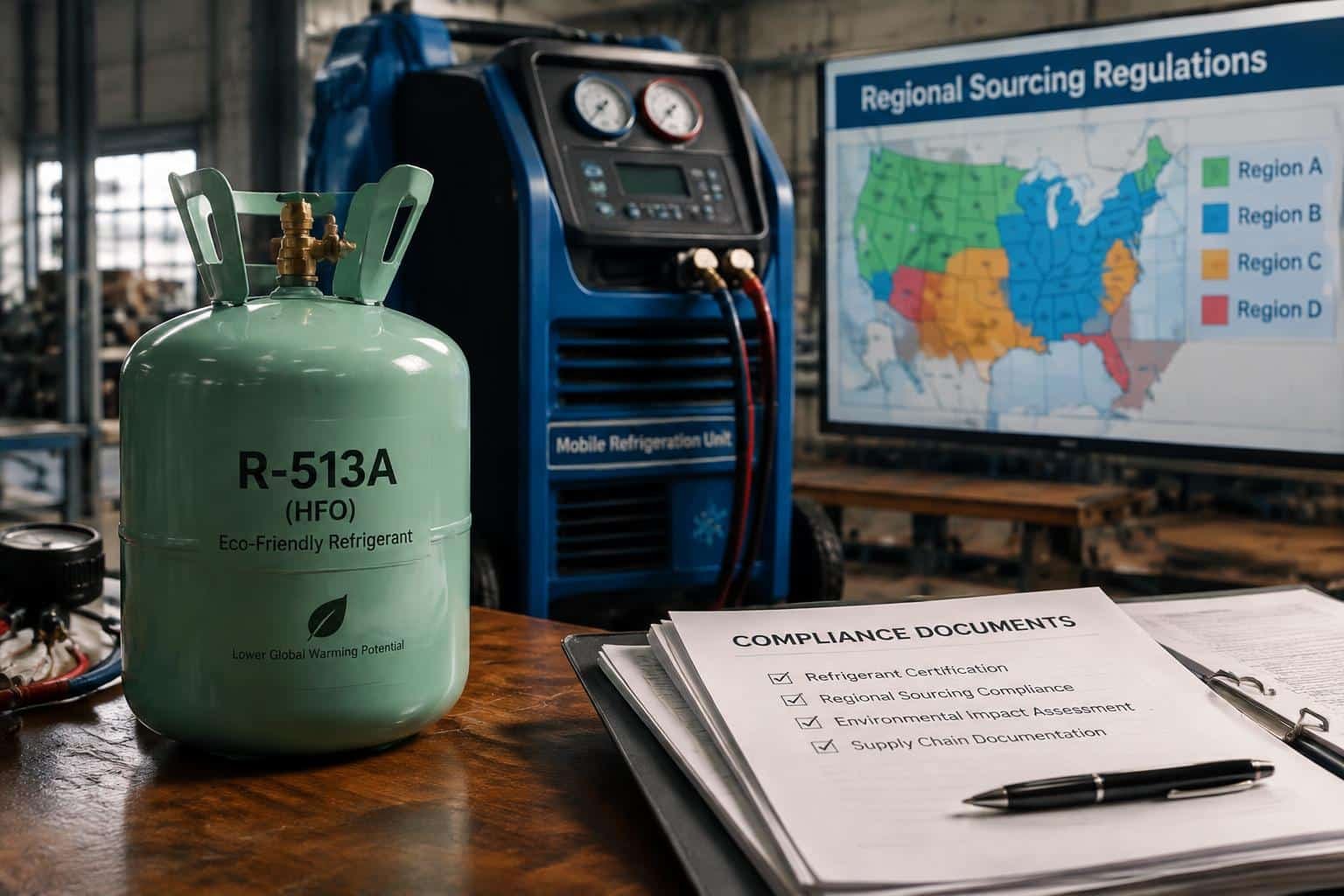
Choosing a lower-impact refrigerant for a vehicle or mobile cooling unit involves more than selecting a chemical with a reduced climate footprint. You must account for the rules that apply where the refrigerant is manufactured, imported, sold, and used, since one product can cross several regulatory borders before reaching a service technician.
Key Takeaways:
- Regional rules follow the jurisdiction where refrigerant is produced, imported, sold, transported, or used. A mobile refrigeration supplier serving several markets must account for each market’s requirements, including rules that apply at customs or during cross-border transport.
- Environmental requirements often distinguish refrigerants by ozone-depletion and global-warming impact. Regional phase-down schedules, restrictions on particular substances, and equipment standards determine which refrigerants and mobile cooling systems are eligible for sale or use.
- Compliance depends on more than the refrigerant’s product label. Buyers and suppliers need applicable safety data sheets, product and import documentation, and evidence of compliance with handling and transport rules; requirements vary by jurisdiction and refrigerant type.
Regional Rules and Their Jurisdiction
Your sourcing decisions are shaped by where a refrigerant is manufactured, where equipment enters commerce, and where it is ultimately sold. Each jurisdiction defines its own boundaries through environmental, product, and trade laws, so a supplier operating across several markets must account for overlapping authorities. A rule can apply to a factory within a region, an importer bringing goods across its border, or a distributor placing products on its market, even when those activities occur in different countries.
National and subnational authority
National governments generally set the legal framework for manufacturing and market access, while states, provinces, or territories can impose additional requirements within their authority. You should identify the rules that apply at each facility and sales destination, since a product made under one national standard may face stricter local conditions before sale. In the United States, for example, federal requirements coexist with state-level measures, so a manufacturer supplying multiple states must account for both layers.
Rules governing cross-border supply chains
Cross-border sourcing brings the laws of the exporting country, transit jurisdictions, and destination market into play. Your importer of record is typically responsible for meeting applicable entry and product-placement requirements, while contractual terms determine how documentation and compliance duties are shared with suppliers. A refrigerant produced abroad does not become exempt from destination-market rules simply because it was legally manufactured at origin; customs declarations and commercial invoices identify the parties and goods entering the market.
Environmental Standards for Mobile Refrigerants
For mobile air-conditioning and refrigeration equipment, environmental rules set limits on the refrigerant’s effects on climate and the ozone layer. You need to assess the substance against the rules that apply where the equipment is manufactured, sold, imported, or operated, since thresholds and implementation dates differ by jurisdiction. These criteria shape which refrigerants are permitted in vehicle systems, transport refrigeration units, and other mobile applications, including alternatives discussed in embracing natural refrigerants for a sustainable future.
Global warming potential and ozone-depletion limits
For a refrigerant used in mobile equipment, global warming potential (GWP) measures its heat-trapping effect relative to carbon dioxide, while ozone-depletion potential (ODP) indicates its capacity to damage stratospheric ozone. You must identify the exact refrigerant blend and assess both values against applicable regional thresholds. Many rules restrict substances with significant ODP, and some impose GWP ceilings for particular equipment categories. Hydrofluoroolefin blends and carbon dioxide have different environmental profiles, so the refrigerant designation matters.
Restrictions on fluorinated gases and phasedown schedules
Fluorinated-gas rules often limit the use of high-GWP hydrofluorocarbons through bans for specified applications, quota systems, or stepwise reductions in permitted supply. You need to distinguish a restriction on placing equipment on the market from controls on servicing existing systems, because the obligations can differ. Regional schedules also set transition dates by product type, including mobile air conditioning. A refrigerant accepted for servicing an older vehicle is not automatically approved for a new model.
Sourcing and Supplier Due Diligence
Before you place an order, establish who manufactured the refrigerant, where it was produced, and which legal entity will supply it. Match the product’s stated composition and intended use to the rules that apply in your market, since an acceptable substance does not make every supplier or source compliant. Request evidence directly from the manufacturer or its authorized distributor, and resolve discrepancies between product labels, safety data sheets, and invoices before approving the purchase order.
Approved substances and supplier qualifications
Confirm that the refrigerant’s chemical designation and blend composition appear on the applicable regional approval or controlled-substance list, using the current version for the market where you will use it. Ask the supplier for its authorization to sell regulated refrigerants, such as a regional trading license or manufacturer appointment, and verify that the named business matches the invoice issuer. For reclaimed or recycled material, require documentation identifying that status and the source of the recovered refrigerant.
Traceability, certifications, and records
Request batch-level records that connect the product container to its manufacturer, production site, refrigerant designation, and batch number. A certificate of analysis should identify composition and purity, while the safety data sheet should match the product and supplier named in the purchase documents. Verify any claimed quality or environmental certification with the issuing body, including its scope and validity. Retain purchase orders, invoices, certificates, and batch identifiers together so each cylinder can be traced to its documented source.
Import, Transport, and Handling Requirements
As you move refrigerant across borders or between facilities, rules attach to the substance, its container, and the people handling it. Your shipment records should identify the refrigerant by its recognized chemical designation and show its quantity, origin, and intended use. Transport classification determines packaging, hazard labels, and carrier documentation, while local handling rules govern storage and recovery. These requirements apply to cylinders and bulk containers, including reclaimed refrigerant sent for processing.
Customs declarations and trade controls
At customs, you must declare the refrigerant accurately under the applicable tariff classification, with product identity, net mass, country of origin, and consignee details matching the invoice and shipping documents. Import permits or quota allocations apply to controlled substances in jurisdictions that implement ozone-depleting substance or fluorinated-gas controls. Check whether the rules cover reclaimed or recycled material, not only virgin refrigerant. A mismatch between the declaration and cylinder label can hold a shipment at the border.
Storage, transport, recovery, and technician requirements
During transport, you must use approved, pressure-rated cylinders, secure them against movement, and display hazard labels required by the route’s dangerous-goods rules. At storage sites, keep cylinders upright, protected from heat, and segregated where local fire or building codes require it. Recovery rules govern equipment and records for refrigerant removed from systems, while technician certification requirements vary by jurisdiction. A recovery log should identify the refrigerant type, amount collected, and receiving facility.
Compliance for Mobile Cooling Systems
Vehicle manufacturers and fleet operators must account for refrigerant requirements throughout a cooling unit’s service life, from component selection to disposal. Rules can shape compressor compatibility, hose and seal materials, charge limits, technician procedures, and the equipment used to capture refrigerant. Your specifications should align the vehicle’s intended markets with the refrigerant and system approvals applicable there. The linked Ecofriendly Hydrocarbon Refrigerant Market: US, Japan, and other markets provides context on regional refrigerant adoption.
System approval and labeling
Before a mobile cooling system enters service, you need to verify that its refrigerant, charge, and components meet the approval requirements for each market where the vehicle will operate. Design records should identify the refrigerant designation, charge quantity, and compatible pressure-rated components, while labels on the unit should communicate refrigerant type and relevant handling hazards. For a vehicle sold across borders, keep approval documents and label language consistent with the destination market’s rules.
Leak prevention, servicing, and recovery
During maintenance, your technicians should use refrigerant-specific service couplings, compatible recovery equipment, and leak-detection methods suited to the system. Inspect hoses, joints, and service ports for leakage, and record refrigerant added or recovered according to applicable requirements. At vehicle retirement, recover the charge into an approved, correctly identified cylinder rather than venting it, then route the material for permitted reclamation or disposal. A service log should link each recovery event to the vehicle identification number.
Enforcement, Penalties, and Market Risks
Noncompliance can affect more than the refrigerant shipment itself: authorities may restrict its import, sale, installation, or use, while contractual obligations and local enforcement rules differ across markets. If you source a refrigerant accepted in one jurisdiction but restricted in another, a cross-border shipment can face detention or rejection at the destination. These differences also complicate responsibility among importers, distributors, and service providers, particularly when product documentation does not match the rules governing the equipment’s final market.
Inspections, reporting, and penalties
During an inspection, you may need to produce import declarations, refrigerant labels, purchase records, and service logs that establish the product’s identity and movement. Reporting duties vary by jurisdiction and may apply to imports, emissions, equipment servicing, or refrigerant recovery. Missing or inconsistent records can trigger corrective orders, shipment holds, fines, or suspension of permits, depending on local law. Authorities may also treat repeated violations more severely than a first documentation failure.
Supply disruption and liability exposure
Restrictions that take effect in one market can leave you with stock that cannot legally be sold or installed there, even if the same refrigerant remains permitted elsewhere. A delayed shipment can interrupt vehicle production or maintenance when compatible refrigerant is unavailable, while rejected goods may incur storage, return, or disposal costs. If a product fails to meet local requirements, your contracts may allocate losses among the importer, supplier, and service contractor, alongside any regulatory liability.
Building a Region-Specific Sourcing Strategy
Set purchasing requirements by destination market, refrigerant type, and equipment application rather than relying on a single global specification. Map each market’s rules to approved products, documentation, and delivery routes, then assign an owner for every requirement. Build supply resilience by qualifying more than one compliant source where available and recording acceptable substitutes before shortages arise. For a retailer operating across borders, the resulting sourcing matrix can distinguish approved refrigerants for each country and mobile cooling system.
Regulatory monitoring and supplier controls
Assign your compliance team to track changes in national refrigerant restrictions, product standards, and import procedures, then translate updates into purchase-order terms. Require suppliers to identify refrigerant composition, provide current safety data sheets, and notify you before changing formulations or manufacturing sites. Retail compliance resources, including Compliance Fact Sheets for Retailers, can support internal monitoring. Keep dated approvals and supplier declarations with each product record.
Procurement planning across markets
Coordinate buyers, logistics teams, and service contractors around a market-by-market forecast that accounts for seasonal demand, lead times, and local restrictions on transport or storage. Specify an approved refrigerant and compatible mobile cooling equipment for each destination, and prequalify alternatives that meet the same rules. Where one supplier serves several countries, separate inventory and shipping instructions by destination to prevent misrouting. A replenishment plan should identify the authorized warehouse and delivery route for each market.
Final Words
Your sourcing decisions must follow the rules that apply where refrigerant is manufactured, shipped, imported, and used, not just the requirements of your company’s home market. Confirm the refrigerant’s permitted composition, supplier documentation, transport classification, and servicing requirements for each destination. A product accepted in one jurisdiction may face different restrictions or import controls in another. Keep the applicable regional approvals and safety data alongside purchase records for every mobile cooling system.