
Every car refrigerant carries environmental consequences beyond the moment it cools the cabin. You encounter those impacts in chemical production, vehicle energy use, servicing losses, and end-of-life recovery. A refrigerant’s climate footprint therefore depends not only on its heat-trapping potential, but also on how efficiently the air-conditioning system operates and how much refrigerant escapes over the vehicle’s service life.
Key Takeaways:
- Refrigerant choice shapes climate impact across production, vehicle operation, servicing, and end-of-life recovery. A low global-warming-potential refrigerant has the greatest lifecycle benefit when leaks are limited and refrigerant is recovered rather than vented during repairs and scrapping.
- Refrigerant performance affects indirect emissions through the energy required to cool the cabin. Compressor load, ambient heat, and system design all influence fuel or electricity use, so the refrigerant’s direct climate impact is only part of its footprint.
- Safety and serviceability influence which refrigerants work in practice. Flammability classification, compatible components, technician training, and recovery equipment shape adoption, while vehicle regulations and servicing standards govern how systems are handled.
Refrigerant Choices and Climate Impact
Your climate comparison depends on both a refrigerant’s global warming potential (GWP) and the amount released during vehicle use. GWP indicates how strongly a gas traps heat relative to carbon dioxide over a defined period, while atmospheric lifetime describes how long it remains in the air. In a car air-conditioning system, those properties set the potential climate effect of each kilogram lost, making refrigerant identity and containment relevant to the same assessment.
Global warming potential and atmospheric lifetime
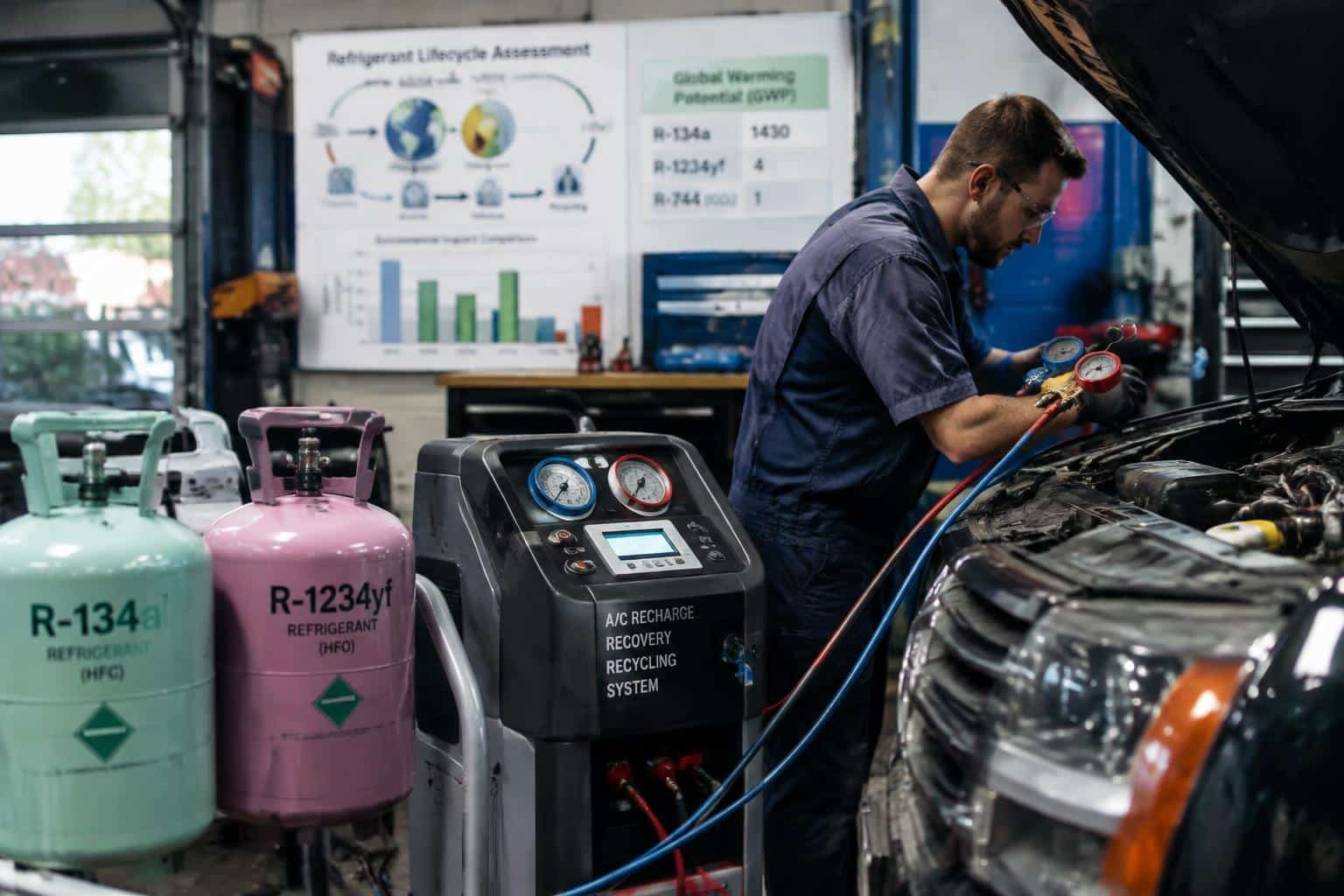
R-134a has a much higher GWP than carbon dioxide, while R-1234yf has a far lower GWP and breaks down relatively quickly in the atmosphere. That difference means equal leaks do not produce equal climate effects. You should read GWP alongside atmospheric lifetime, since persistence shapes how long emissions influence warming. Carbon dioxide, used as a reference gas, has a complex atmospheric response rather than a single short lifetime, so refrigerant comparisons rely on defined assessment periods.
Direct emissions from leaks and servicing
Leakage turns a refrigerant’s GWP into a direct emissions concern: a damaged condenser, deteriorated hose, or loose service connection can release gas from the circuit. You should also account for refrigerant vented during recovery or charging, because servicing practices affect how much escapes. Technicians use recovery equipment to capture refrigerant before opening a system, and leak detectors help locate faults such as a leaking evaporator joint before recharge.
Regulatory changes and refrigerant transitions
Regulations have pushed vehicle manufacturers from higher-GWP refrigerants toward lower-GWP alternatives, with R-1234yf widely adopted in newer passenger cars. You may still encounter R-134a in older vehicles, so the correct refrigerant depends on the vehicle’s label and service specifications. Substituting one gas for another without approved components and procedures can compromise system performance and safety. A service technician should confirm the specified refrigerant and use compatible recovery and charging equipment.
Impacts Across the Refrigerant Life Cycle
You encounter refrigerant-related emissions at several points beyond use inside a vehicle: chemical production, cylinder handling, service recovery, and final treatment. Each stage has distinct sources, including energy consumed in manufacturing, leakage during transfer, and releases from damaged or improperly processed equipment. Tracking the refrigerant’s path through suppliers, workshops, and waste handlers gives you a clearer account of these direct emissions. Regulatory changes also shape which substances and handling practices enter that chain; see how regulatory changes are impacting the automotive industry.
Raw materials and refrigerant manufacturing
Feedstock extraction and chemical processing create emissions before a refrigerant reaches an automotive supplier. For hydrofluorocarbons, manufacturing involves fluorochemical inputs and energy-intensive production steps, while lower-global-warming-potential alternatives have their own material and process requirements. You can assess this stage through supplier disclosures covering feedstock origin, manufacturing energy, and plant emissions rather than relying only on the refrigerant’s climate properties during release. Production records also identify the refrigerant blend and batch used in a vehicle’s original charge.
Transport, recovery, and end-of-life destruction
Bulk refrigerant moves through production plants, distributors, and service facilities, with emissions possible during cylinder filling, connection, or transfer. At a workshop, a certified recovery machine draws refrigerant from the vehicle into a sealed cylinder instead of venting it during repair. End-of-life treatment then depends on the collected gas: contaminated or unusable refrigerant requires approved destruction, while poor handling can release it during draining or equipment failure. Your service records can document recovery quantities and the receiving waste facility.
Recycling, reclamation, and refrigerant circularity
Recovered refrigerant does not automatically qualify for reuse. Recycling equipment removes oil and some contaminants at the service site, while reclamation processes the gas to meet an applicable purity specification before it returns to commerce. You can trace circularity through cylinder labels, refrigerant identifiers, laboratory purity results, and records linking recovered material to its next user. Keeping compatible refrigerants separate matters: mixing different types can complicate testing and leave a batch unsuitable for reclamation.
Vehicle Efficiency and Indirect Emissions
Cabin cooling adds an energy load that affects a vehicle’s fuel use or driving range, so refrigerant properties and air-conditioning design matter beyond direct refrigerant emissions. Compressor work, heat-exchanger performance, and control strategy determine how much engine power or battery energy the system draws during operation. For context on refrigerant development, see Pioneering Sustainability: The Evolutionary Journey of 1234yf Refrigerant.
Cooling performance and energy demand
Efficient heat transfer reduces the compressor effort needed to meet your cabin’s cooling demand. Refrigerant pressure-temperature behavior, evaporator surface area, condenser airflow, and expansion-valve control all shape that workload. In hot weather or stop-and-go traffic, restricted airflow across the condenser can raise system pressure and increase compressor demand. A well-matched system maintains the target cabin temperature with less energy, limiting the additional fuel consumption or battery draw associated with air conditioning.
System design, charge size, and leak prevention
Refrigerant charge must match the specified system volume and component design: too little charge can weaken cooling, while excess charge can impair heat exchange and raise operating pressures. Compact line routing, sound joints, and correctly fitted service ports reduce leakage pathways; leak prevention also limits the need for repeated recharging. For your vehicle, the manufacturer’s specified charge mass and refrigerant type are the relevant service references, often printed on an under-hood label.
Differences between combustion, hybrid, and electric vehicles
In a combustion vehicle, the belt-driven compressor draws power from the engine, so cabin cooling can increase fuel demand, especially at idle. Hybrids often use an electrically driven compressor, allowing cooling to continue when the engine stops, but the energy still affects fuel use through battery management. Battery-electric vehicles draw that energy from the traction battery, directly affecting available range. Heat-pump systems can also share thermal hardware between cabin conditioning and battery temperature control.
Safety, Servicing, and Real-World Performance
Service conditions shape how a refrigerant performs throughout a vehicle’s working life, from routine inspections to collision repairs. You depend on compatible fittings, sound seals, and correct charging procedures to limit leaks and maintain reliable cabin cooling. Refrigerant properties also dictate the equipment and precautions used in a workshop, so a vehicle’s service history matters alongside its system design. Practical lifecycle management, as explained in how lifecycle refrigerant management works and supports industry, starts at the service bay.
Flammability, toxicity, and pressure considerations
Before opening a system, you need to identify its refrigerant and follow the vehicle maker’s service procedure. Mildly flammable refrigerants require suitable ventilation, ignition-source control, and compatible recovery equipment; toxicity risks call for preventing exposure in confined work areas. Operating pressures also vary by refrigerant and ambient conditions, so technicians use specified gauges and hoses rather than assuming components are interchangeable. A refrigerant label and under-hood service decal provide the starting point for selecting precautions.
Technician training and service infrastructure
Proper training connects refrigerant-specific hazards with the tools used for diagnosis, recovery, and recharge. You need technicians who can distinguish fittings, interpret pressure readings, and prevent cross-contamination between refrigerants. A workshop’s infrastructure should include dedicated recovery machines, identified storage cylinders, leak-detection equipment, and procedures for ventilating enclosed service bays. Clear equipment labeling reduces mix-ups when several vehicle platforms enter the same shop, particularly during seasonal air-conditioning service.
Detection, repair, and refrigerant recovery
Accurate leak detection begins with a method suited to the refrigerant, such as an electronic detector or approved tracer procedure. After locating a leak at a hose, condenser, or joint, technicians repair the source before recharging, rather than topping up a system that will release refrigerant again. Recovery equipment removes the remaining charge into a designated cylinder, while recorded quantities support responsible handling. A final pressure and leak test verifies the repaired circuit before the vehicle returns to service.
Standards, Regulation, and Industry Transition
Your refrigerant choices are shaped by rules that set acceptable substances, equipment requirements, and service practices, while market readiness determines how quickly manufacturers and repair networks can comply. Adoption depends on more than regulatory approval: automakers need qualified suppliers, vehicle platforms designed for the refrigerant, and technicians trained to handle it. These requirements often lead to phased transitions, with approved refrigerants entering new vehicle models before older vehicles leave the service fleet.
Global and regional refrigerant regulations
Regional rules set different timelines and conditions for automotive refrigerants, so a vehicle designed for one market may need a different specification elsewhere. In the European Union, mobile air-conditioning requirements restrict refrigerants with high global warming potential in new vehicle types; other jurisdictions apply their own climate policies and safety standards. If you source or service vehicles across borders, verify the applicable rules for the model year and sales market, as well as restrictions on refrigerant sales and handling.
Compliance testing and lifecycle assessment methods
For type approval, manufacturers document refrigerant identity, system design, and compliance with applicable safety and environmental requirements. Testing can include leak detection, pressure performance, and evaluation of components under specified operating conditions, with methods set by regulators or recognized technical standards. Lifecycle assessment adds a broader accounting boundary, tracking emissions associated with refrigerant production, vehicle use, leakage, and end-of-life recovery. Your assessment results depend on the stated assumptions, including service loss rates and recovery practices.
Costs, availability, and transition planning
Supplier capacity, cylinder availability, compatible service equipment, and technician training all affect how readily a refrigerant enters the vehicle market. A transition plan must account for new-model production as well as the installed fleet, since repair shops may need separate recovery machines, fittings, and refrigerant stocks. In markets with limited supply, procurement interruptions can complicate routine servicing; automakers and distributors therefore coordinate approved refrigerant specifications with parts and service networks before a model launch.
Conclusion
Your choice of car refrigerant shapes more than tailpipe-free cabin cooling: it affects climate impact during production, energy use in operation, leakage risk, recovery, and disposal. A low-global-warming-potential refrigerant offers a benefit only when its system is efficient, safely serviced, and managed at end of life. As regulations and vehicle designs change, lifecycle performance will distinguish effective replacements from simple chemical substitutions, with compressor demand, refrigerant recovery, and technician handling all part of the outcome.