
As vehicle makers rethink cabin air conditioning, R-744, the refrigerant-grade name for carbon dioxide, is gaining attention as an alternative to conventional refrigerants. You encounter it in systems engineered for high operating pressures, with components designed around CO₂’s distinct thermodynamic properties. Its low global warming potential makes R-744 a notable option for automotive climate control.
Key Takeaways:
- R-744 is carbon dioxide used as a vehicle refrigerant. Its very low global warming potential draws attention as automakers assess alternatives to higher-impact refrigerants.
- R-744 systems operate at substantially higher pressures than conventional automotive air-conditioning systems. Their compressors, heat exchangers, valves, and service equipment must be designed for those pressures.
- R-744 offers strong heat-pump potential for cabin heating, including in electric vehicles, but performance varies with operating conditions and system design. Transcritical operation is a key engineering consideration.
Why R-744 Is Drawing Attention
For you, the growing interest in R-744 reflects a shift in how automakers weigh cabin comfort against the environmental profile of refrigerants. Carbon dioxide is a naturally occurring substance, and its low global warming potential distinguishes it from many conventional automotive refrigerants. As manufacturers respond to tighter rules and changing expectations around climate impact, R-744 has become a serious option for vehicle air conditioning, rather than a niche alternative confined to specialist applications.
R-744’s role in automotive air conditioning
In an automotive air-conditioning system, R-744 circulates as the refrigerant that transfers heat away from the cabin and releases it outside the vehicle. You encounter the same core function as with other refrigerants, but carbon dioxide gives automakers a different environmental profile to assess. Its suitability has attracted attention across passenger vehicles and commercial platforms, particularly as manufacturers plan systems with long service lives and broader regulatory requirements.
Environmental impact and regulatory context
Because R-744 has a global warming potential of 1 under commonly used assessment conventions, its direct climate impact is substantially lower than that of high-GWP refrigerants if released. For you, the regulatory context matters because rules in several markets restrict or phase down refrigerants with greater climate impact, encouraging manufacturers to evaluate alternatives. Carbon dioxide is not exempt from handling requirements, but its environmental profile makes it relevant to automakers planning for evolving refrigerant policies.
How R-744 Systems Work
In your vehicle, R-744 moves through a sealed refrigeration circuit as carbon dioxide, with operating pressures that shape the layout and rating of its components. Rather than condensing at typical automotive ambient temperatures, the refrigerant often rejects heat above its critical point, so the system operates transcritically. That pressure-driven design connects the compressor, gas cooler, expansion device, and evaporator in a controlled loop; R744/CO₂ systems in recent Mercedes and Volkswagen models illustrate its automotive application.
Transcritical CO₂ refrigeration cycle
During operation, your compressor raises the refrigerant’s pressure and temperature before sending it to the gas cooler. Because CO₂ above its critical point does not condense into a liquid there, heat leaves the refrigerant while it remains a dense fluid. The expansion valve then reduces pressure, cooling the refrigerant before it enters the evaporator and absorbs cabin heat. Returning vapor completes the circuit, with the high-side pressure controlled to suit the system’s operating conditions.
Key components and high-pressure operation
In an R-744 circuit, your compressor, gas cooler, evaporator, expansion valve, and connecting lines must be rated for CO₂’s high operating pressures. Pressure sensors and electronic controls regulate the high side, while the expansion valve meters refrigerant into the low-pressure evaporator. The gas cooler replaces the conventional condenser’s role during transcritical operation, and fittings, seals, and service equipment are specified for the pressure range. These components form a tightly controlled circuit from compressor discharge to evaporator return.
Performance Benefits and Engineering Trade-Offs
Across a vehicle’s operating range, R-744 combines useful heat-pump performance with demanding pressure conditions. Its heating and cooling capacity depends on ambient temperature, cabin load, and how the refrigerant cycle is controlled, so you experience different strengths in winter and summer operation. The same high operating pressures that require careful component design also support compact heat exchangers and effective heat transfer, making performance and pressure management closely linked engineering considerations.
Heating performance in cold weather
During cold starts, an R-744 heat pump can extract heat from outside air and deliver it to the cabin, even when ambient temperatures are low. Because carbon dioxide’s critical temperature is relatively low, the cycle operates transcritically under many conditions, with the gas cooler releasing heat efficiently. You may also see supplemental heating used when frost, very low temperatures, or rapid cabin warm-up demands exceed the heat pump’s available capacity.
Efficiency across operating conditions
Across changing ambient temperatures, R-744 system efficiency depends on gas-cooler pressure, compressor speed, and the temperature difference between the refrigerant and the air or coolant. A well-controlled cycle can provide effective cooling in hot weather and useful heat in winter, while operating points away from the optimum reduce efficiency. For instance, cabin cooling performance can improve when the gas cooler rejects heat effectively, rather than recirculating warmed air around the condenser.
Pressure, durability, and safety considerations
R-744 operates at substantially higher pressures than common automotive refrigerants, so its compressors, hoses, joints, and heat exchangers require pressure-rated construction. You need components designed to withstand both normal transcritical operation and pressure changes during shutdown and temperature swings. Carbon dioxide is nonflammable, but a leak in an enclosed cabin can displace oxygen; sealed connections, pressure relief devices, and service procedures suited to high-pressure equipment remain essential details.
Vehicle Integration and System Design
Integrating R-744 into a vehicle requires coordinated changes to the refrigerant circuit, component layout, and control strategy. You need to account for its high operating pressures when specifying lines, joints, sensors, and housings, while fitting the system around existing cabin and powertrain hardware. The design also links heating and cooling functions, so control logic must respond to changing cabin demand and available waste heat. Supplier and development context is outlined in Suppliers, Research & Timelines – R744 – Natural Refrigerants.
Heat pumps and thermal management
For a heat-pump application, you route R-744 through a circuit that can reverse heat flow between the cabin and the outside environment. The system’s gas cooler, evaporator, and refrigerant valves must work with coolant loops serving components such as the battery and electric drive. You also need controls that coordinate cabin comfort with battery temperature limits, particularly during cold starts, when cabin heating and battery conditioning compete for available thermal energy.
Compressors, heat exchangers, and controls
R-744’s high-side pressure calls for a compressor, fittings, and heat exchangers designed for the refrigerant’s operating conditions. Gas-cooler performance depends on airflow and the temperature of the air entering the core, so packaging and fan control affect heat rejection. Electronic expansion valves and pressure sensors give the controller precise inputs for managing refrigerant flow. Your calibration must coordinate compressor speed, valve position, and fan operation across heating, cooling, and defrost modes.
Packaging and service requirements
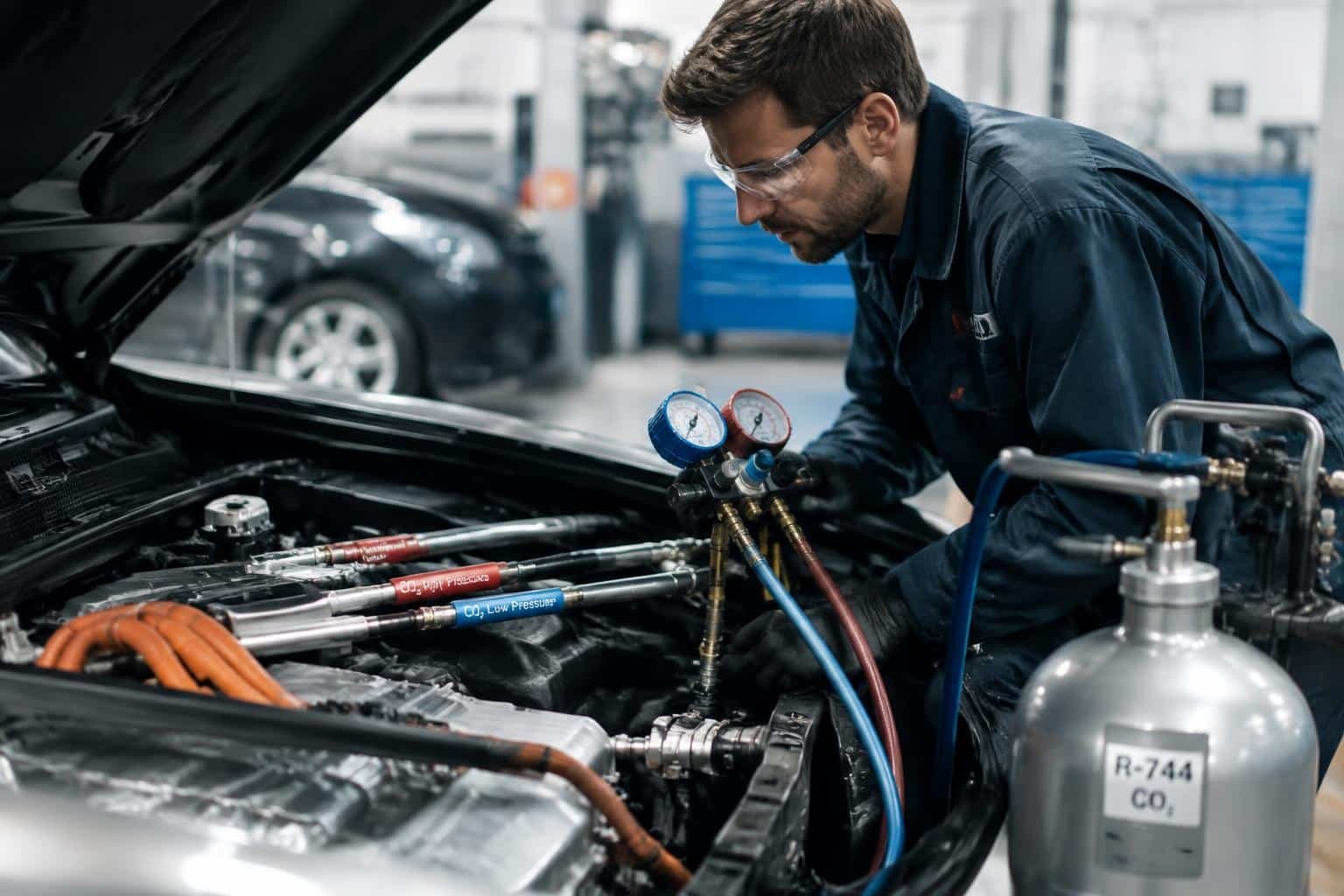
Underhood packaging must accommodate pressure-rated tubing and connections while protecting them from vibration, abrasion, and impact. You also need to account for access to service ports and components, since R-744 equipment requires appropriate recovery tools and procedures. Clear labeling and technician training support safe handling during maintenance, while leak detection and pressure checks follow the vehicle manufacturer’s service instructions. A practical layout keeps the compressor and service connections accessible without crowding adjacent powertrain hardware.
Adoption, Regulation, and Market Outlook
For your view of R-744’s market trajectory, track how vehicle rules and engineering investment influence development decisions. Automakers and suppliers are evaluating carbon dioxide heat-pump architectures for electric vehicles, while regulatory requirements shape refrigerant choices across regions. You can follow technical work through the (PDF) R744 heat pump solutions for electric vehicles, which examines applications in this setting. Adoption remains tied to production readiness, service capability, and the requirements governing each vehicle market.
Global regulatory drivers
Across major automotive markets, refrigerant rules and climate policies influence which systems manufacturers develop and qualify. R-744 has a very low global warming potential compared with commonly used automotive refrigerants, making it relevant to regulations that restrict high-impact alternatives. You should distinguish vehicle-level requirements from regional rules on refrigerant handling, labeling, and servicing, since these affect both system design and aftermarket procedures. Compliance planning also accounts for standards for pressure-rated components and technician training.
Automaker and supplier activity
Automaker programs and supplier engineering investment are expanding the technical groundwork for R-744 systems. You will find activity concentrated in heat pumps for electric vehicles, where component suppliers develop compressors, valves, heat exchangers, and controls designed for high operating pressures. Collaboration between vehicle manufacturers, tier-one suppliers, and research teams supports prototype testing and integration work. The published R744 heat-pump research linked above provides one example of this development focus.
Barriers to widespread adoption
For your assessment of deployment constraints, account for the high pressures that R-744 equipment must withstand. Compressors, joints, heat exchangers, and service tools require suitable pressure ratings, while technicians need procedures specific to carbon dioxide systems. Manufacturers also weigh component availability, production costs, packaging, and performance across differing climates. Existing service networks are more familiar with established automotive refrigerants, so broader use depends partly on training and access to R-744-compatible recovery and diagnostic equipment.
To wrap up
R-744 systems are gaining attention because carbon dioxide refrigerant has very low global warming impact and supports effective heating and cooling across varied conditions. For you, the shift also means weighing those benefits against high operating pressures, specialized components, and service requirements. Automakers and technicians must account for heat exchangers, compressors, and pressure controls designed specifically for CO₂. As regulations and vehicle platforms evolve, R-744’s role will depend on how well its environmental advantages fit each vehicle’s performance and packaging needs.