
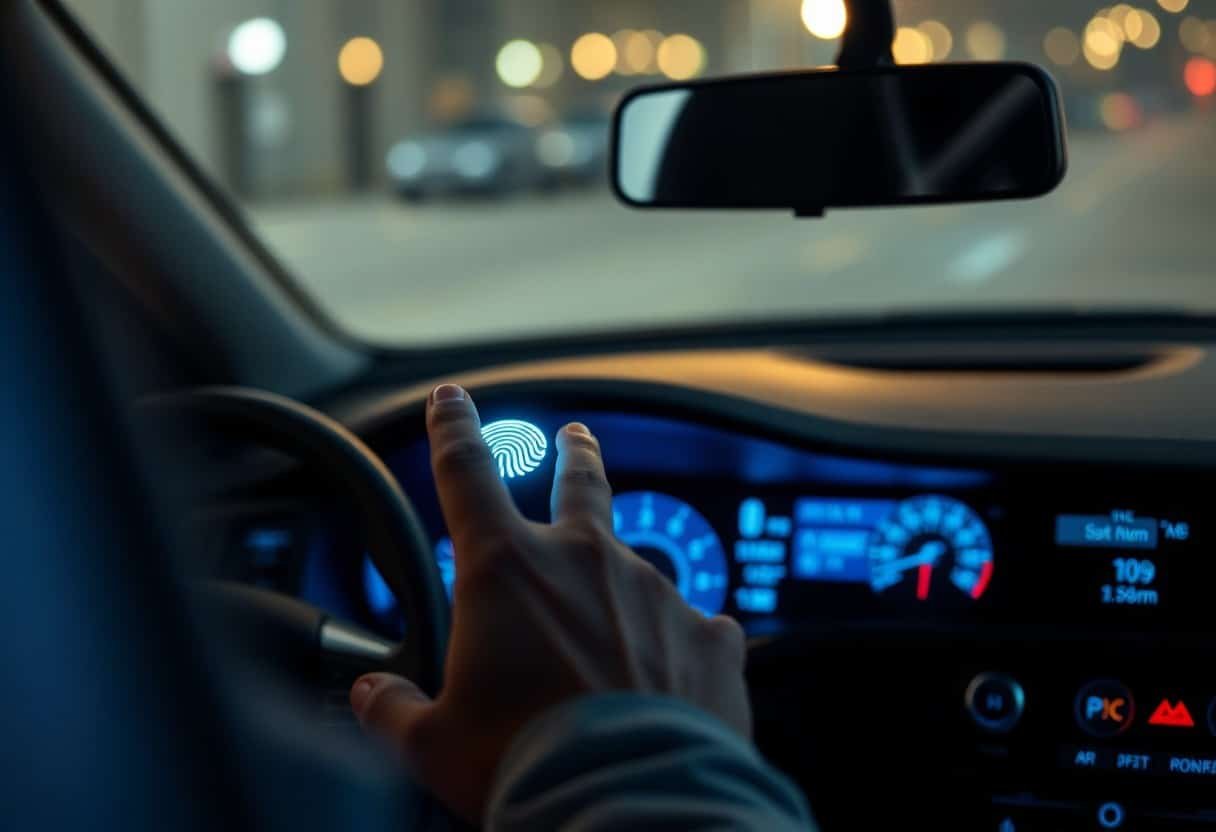
Biometrics enable vehicles to identify you instantly-using fingerprint, facial, and voice recognition-to load your driving profile, adjust seat and mirror positions, optimize infotainment and climate settings, and tailor safety systems and driving modes to your habits; by securely linking preferences to your identity, the car anticipates your needs and delivers consistent, efficient personalization every time you drive.
Key Takeaways:
- Biometric identification (face, fingerprint, voice, gait) automatically recognizes drivers and loads personalized settings-seat, mirrors, climate, navigation and infotainment-improving convenience and consistency across vehicles.
- Continuous physiological and behavioral monitoring (eye tracking, heart rate, skin conductance) enables real-time safety and comfort adjustments-drowsiness or stress detection can trigger alerts, ADAS tuning, or climate and audio changes to reduce risk and fatigue.
- Effective deployment balances personalization with privacy and security: on-device processing, encryption, consent-driven profiles, and clear data governance are needed to protect sensitive biometric data while enabling adaptive, accessible interfaces.
Understanding Biometrics
What are Biometrics?
Biometrics are measurable physiological and behavioral traits you use for identity: fingerprints, facial geometry, voiceprints, iris texture and ECG patterns. In vehicles, these cues let your car map profiles to seat, mirror, climate and infotainment settings. Modern fingerprint modules often verify identities with >98% accuracy, and camera systems add liveness checks so your vehicle can authenticate and adapt within seconds.
Types of Biometric Technologies
Fingerprint, facial, voice, iris/retina and cardiac (ECG) systems each serve different roles: fingerprints for ignition and presets, cameras for passive driver ID and attention monitoring, microphones for voice-based personalization, iris for distant secure access, and ECG for continuous, hard-to-spoof authentication; Mercedes and BMW already use cabin-facing cameras in production and pilot programs to monitor driver attention and safety.
| Fingerprint | Fast ignition and profile recall at door handles or start buttons |
| Facial recognition | Passive driver ID, attention monitoring, seat/AV customization |
| Voice | Personalized audio profiles, hands-free commands, wake-word auth |
| Iris/Retina | High-security access at range and in varying light conditions |
| ECG / heartbeat | Continuous authentication and biometric health signals |
- Place sensors where you naturally interact-door, steering column, headrest-to minimize friction and reduce latency.
- Blend on-device templates with local edge processing so you keep responses sub-second (<500 ms) and limit cloud exposure.
- Test across 100+ drivers to validate demographic performance and run liveness checks to counter spoofing.
- Any biometric deployment you design should include user consent flows, encrypted templates, and clear fallback methods like PIN or key fob.
When you select and fuse modalities, prioritize robustness: combine fingerprint or ECG for secure unlocking with camera-based attention for continuous contexts to reach sub-second (<500 ms) personalization. You must account for lighting, noise, gloves and seating posture, enforce template encryption, and log performance across diverse populations to spot bias and improve model updates.
Vehicle Interfaces and Personalization
Interfaces increasingly tie biometrics to profiles so when you approach the car a fingerprint or face scan can load seat, mirror, climate and infotainment presets instantly; OEMs like Mercedes (MBUX) and Tesla already store multiple driver profiles for steering, seat and climate, and integrating biometrics removes manual selection-see How biometrics will enhance the connected car experience for implementation examples.
Current State of Vehicle Interfaces
You interact with a mix of large touchscreens (10-15″ common), voice assistants, physical and haptic controls, plus smartphone mirroring across most models; automakers ship multiple driver profiles for seats, mirrors and presets, while OTA updates and cloud accounts let your preferences evolve-infotainment ecosystems now prioritize seamless switching between manual controls and adaptive UI elements tuned to driving context.
Importance of Personalization in Vehicles
You rely on personalization to reduce in-trip adjustments: saved presets for seat, mirrors, climate, head-up display layout, preferred ADAS sensitivity and navigation destinations cut distraction and speed task flows. OEMs map dozens of parameters to profiles so you get consistent ergonomics and a familiar HMI immediately, improving comfort and allowing you to focus on driving rather than fiddling with settings.
Profiles backed by biometrics also enable cross-vehicle continuity: your settings can follow you via a cloud-linked account or be securely stored on-device for shared or rental cars, while policy choices let you select on-device matching for privacy or cloud sync for convenience-this flexibility matters when fleets, ride-share or multi-driver households need rapid, authenticated personalization.
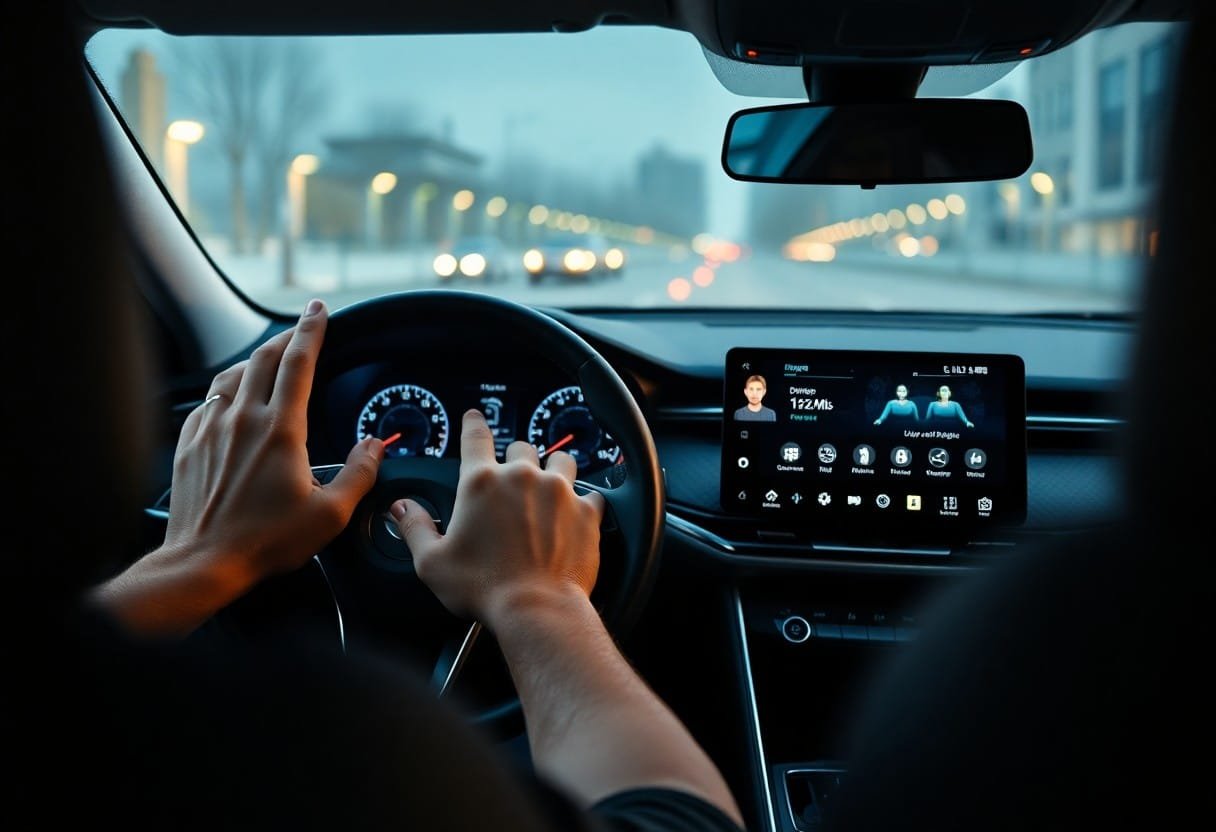
Implementing Biometrics in Vehicles
To deploy biometrics you must choose sensors, secure processing and data policies that meet automotive standards; start by evaluating solutions in the ID Tech whitepaper: Biometrics on the Road to Automotive Identity – ID Tech. You should aim for sub-second authentication, local template storage, compliance with UNECE R155 and ISO/SAE 21434, and clear fallback paths such as PIN or smartphone key.
Biometric Authentication Methods
You can combine fingerprint, facial, voice, vein and cardiac sensing to balance UX and security; fingerprint and facial systems typically enable sub-second verification while behavioral and voice biometrics provide continuous authentication. Implement match-on-device or secure-enclave matching to keep templates local, tune FAR/FRR per use case, and pair biometrics with a PIN or smartphone token for two-factor setups seen in multiple OEM pilots.
Integration with Vehicle Systems
You should integrate biometrics with door locks, ignition, driver profiles, seat and HVAC adjustments and infotainment preferences; many vehicles support 3-5 driver profiles that load automatically on authentication. Use standard transports like CAN or Automotive Ethernet and middleware such as Android Automotive or QNX to convert biometric events into domain-specific actions with minimal latency.
Architecturally, sensors feed a TEE or secure element that performs matching and issues signed assertions delivered over secured CAN/DoIP channels; OEMs implement PKI, secure boot, OTA-signed updates and template encryption, and require automotive-grade components (AEC‑Q100) plus environmental testing to −40°C/85°C. You should target end-to-end latency under 500 ms and design privacy controls so templates never leave the vehicle without explicit consent.

Benefits of Biometric Personalization
Biometric personalization compresses security, safety and comfort into an automatic experience: your face or fingerprint can unlock the car, load seat/mirror/climate presets in under 2 seconds, and feed anonymized driver-state data to adaptive safety systems. You get fewer manual adjustments, faster route tailoring, and potential insurance or fleet savings as behavior-based programs mature. Implementation with on-device templates and liveness checks minimizes data exposure while enabling continuous personalization throughout the drive.
Enhanced Safety and Security
Your biometric ID replaces weak PINs and physical keys with stronger authentication-Touch ID’s reported false-acceptance rate of about 1 in 50,000 and Face ID’s 1 in 1,000,000 illustrate performance benchmarks used in automotive systems. Combined with liveness detection and secure enclaves, these methods prevent spoofing and keep templates off the cloud. You also benefit when biometrics feed driver-state modules that throttle warnings or lock vehicle functions if fatigue or intoxication is detected.
Improved User Experience
You get instant personalization: biometrics trigger stored profiles for seat, mirrors, steering feel, climate and infotainment so the vehicle matches your preferences as soon as you sit. Recognition typically occurs in under 2 seconds, cutting pre-drive fiddling and reducing distraction. OEMs already use fingerprint or phone-key systems to map individual navigation presets, music libraries and app layouts to a biometric profile for seamless handover between drivers.
Beyond basic settings, biometrics enable contextual adaptation-if your heart rate or gaze imply stress, the system can mute notifications, switch to a soothing playlist, and nudge eco or comfort drive modes; if you tend to commute differently on weekdays, the car can pre-load preferred routes and parking spots. These features increase satisfaction and can shave minutes off trip setup every day.
Challenges and Considerations
You must weigh interoperability, regulation and real-world robustness when scaling biometric personalization: sensors need automotive-grade qualification (AEC standards) and must work across -40°C to +85°C, while anti-spoofing must align with ISO/IEC 30107. Deployments also face legal limits-GDPR treats biometric data as special-category-and you should review vendor claims against independent tests like NIST FRVT. For a practical primer on in-vehicle fingerprint and facial systems, see Biometric Car Security: Fingerprint and Face Recognition …
Privacy Concerns
You deal with highly sensitive identifiers, so design choices matter: keep templates on-device in a hardware-backed enclave, encrypt data at rest and in transit, and obtain explicit consent with clear retention policies. Under GDPR and similar laws you must justify processing, enable deletion requests, and prefer pseudonymization. Post-market telemetry should be opt-in, and you should publish privacy impact assessments to show how biometric matching, storage duration, and secondary uses are controlled.
Technological Limitations
You will encounter sensor and algorithm limits: face matching degrades in low light and with occlusions, while fingerprint readers fail with gloves or dirt. Automotive components must meet AEC and operate across wide temperature ranges, and in-cabin compute budgets constrain on-device ML complexity. NIST FRVT has shown significant variance across facial algorithms, so you should validate models across demographics and lighting conditions before deployment.
Additional technical hurdles include presentation attacks and latency: you need robust PAD (per ISO/IEC 30107) and low-latency pipelines to keep start-up under user tolerance. Multimodal fusion (face+finger or face+behavioral) and continuous authentication can reduce false accepts and false rejects, but they raise cost, power draw and integration complexity-trade-offs you must quantify in pilot fleets to balance UX, safety and budget.
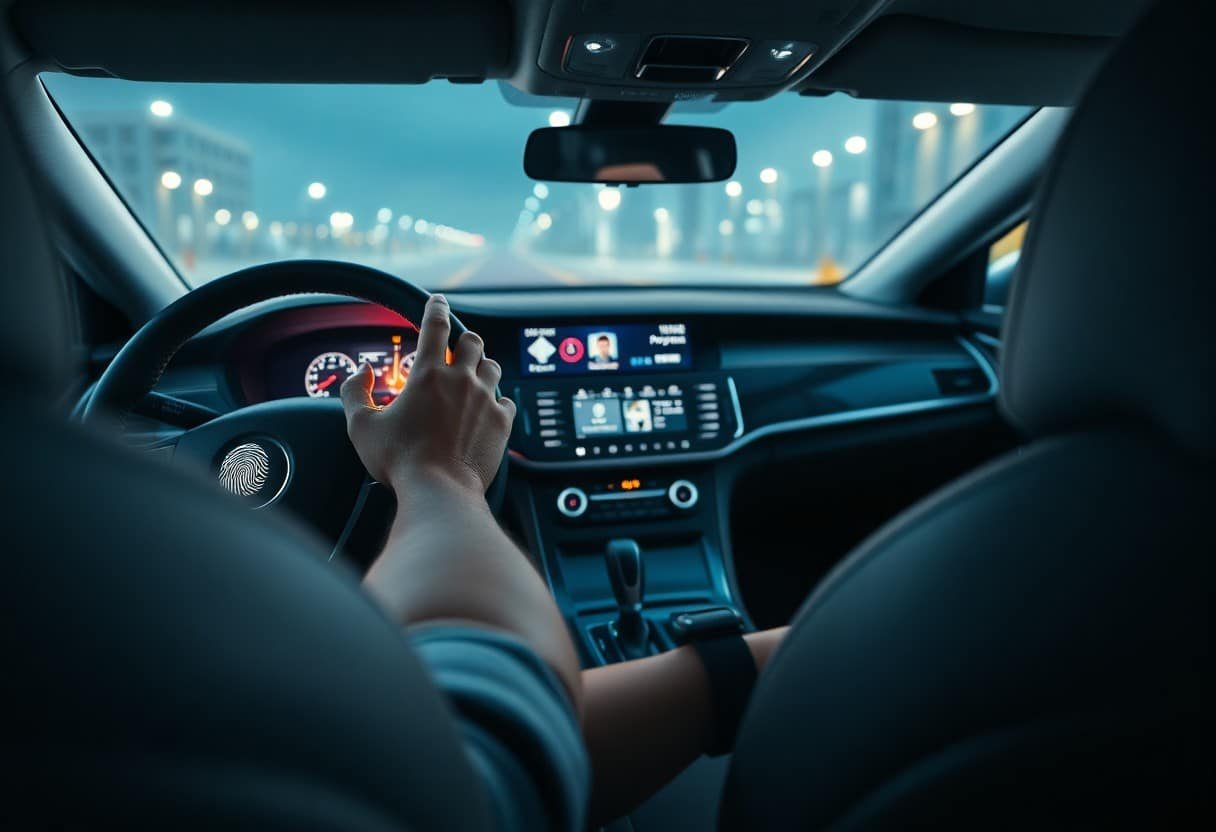
Future Trends in Biometric Vehicle Interfaces
By 2030 you’ll see biometrics move from single-point authentication to continuous, adaptive personalization, blending face, voice, fingerprint and physiological signals for seamless profiles. OEMs already testing multi-modal stacks cite faster lock/unlock, per-driver seat, mirror and HVAC presets, and adaptive ADAS sensitivity; studies show multi-sensor approaches reduce false-reject rates by over 40% compared with single modalities, so your car will increasingly learn and anticipate your preferences in real time.
Innovations on the Horizon
Expect innovations like steering-wheel ECG sensors, in-cabin affective computing, and gait-based entry to mature; suppliers such as Bosch, Smart Eye and Qualcomm are piloting camera-to-sensor fusion and on-device AI to keep latency under 50 ms. You’ll also encounter privacy-preserving techniques-federated learning and edge-first templates-that let your vehicle personalize settings without raw biometric data leaving the car, demonstrated in recent pilot deployments by several Tier-1 suppliers.
Market Predictions
Analysts project double-digit CAGR for automotive biometrics through the decade, with more than half of luxury and upper-mid models offering some biometric personalization by 2028 and broader market penetration by 2030. You can expect hardware costs to drop as sensor integration increases, shifting the value to software subscriptions and data services that monetize continuous personalization and enhanced safety features.
Deepening that outlook, revenue will increasingly split between one-time hardware fees and recurring software/data tiers, with OEMs licensing cloud analytics for aggregated, anonymized usage insights. You’ll likely pay for advanced profile-sharing across family fleets, premium security packages, and over‑the‑air biometric model updates, while regulatory pressure in regions like the EU and China will shape what biometric data your vehicle can store or transmit.
Conclusion
Presently biometrics let your vehicle recognize you instantly and adapt settings-seat, mirrors, climate, infotainment, driving mode-based on your profile, habits and physiological state. By combining fingerprint, facial, voice and sensor data, the interface learns your preferences, enhances convenience, strengthens security and adjusts safety and assistance features to suit your needs, making each drive uniquely tailored to you.