
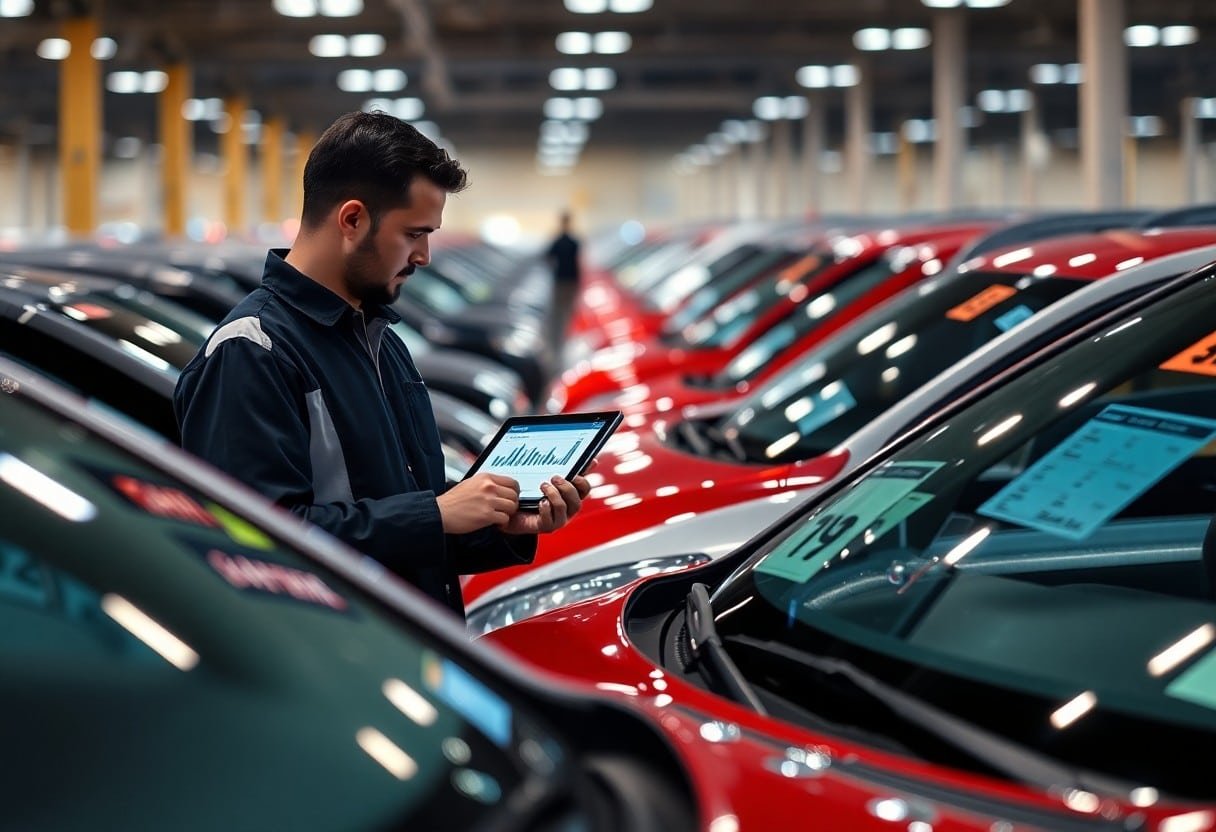
There’s growing evidence that AI-driven inventory management can help you predict demand, price competitively, and optimize turnover so your lot stays stocked with the right models at the right time, helping you reduce holding costs and spot emerging trends that boost your sales.
Key Takeaways:
- AI-driven demand forecasting and dynamic pricing tighten days‑to‑sell and align inventory mix with local market signals.
- Machine learning automates sourcing, reconditioning prioritization, and trade valuation to improve margins and turnover.
- Data quality, systems integration, and model governance determine ROI-continuous retraining and human oversight are required for sustained gains.
Why used-car inventory is tricky
You juggle thousands of unique SKUs-each model year has 8-12 trims, multiple option packages, and variable wear-so forecasting supply is messy. Trade-in timing is unpredictable, condition assessments differ, and residual values swung about 30-40% between 2019-2021 after the supply shock, then softened in 2022-23. That volatility feeds mismatches: too many aging cars, or frequent stockouts of in-demand vehicles, both hurting margins and cash flow.
Demand swings & seasonal effects
Demand surges swing quickly: convertible and soft-top searches spike 25-40% in May-July, while AWD SUVs see a 15-25% lift in November-February in snowy regions. Tax-refund season (Feb-Apr) often increases buyer activity by roughly 10-15%, and end-of-quarter promotions create artificial shortages. You must align acquisitions to these windows or face slower turns and deeper discounts.
Pricing volatility and aging stock
Prices can change daily: wholesale auction swings, fuel-price shocks, or a hot new model can force rapid markdowns. You might buy a midsize sedan at $12,000 and after 45-60 days need to cut $800-1,500 to move it. Profit erosion comes from markdowns plus reconditioning-so aging inventory becomes a compounding cost rather than a one-time hit.
Pricing volatility and aging stock – deeper look
To quantify the hit, factor in $500-$1,200 average reconditioning per vehicle and floorplan interest-about 7% annually means roughly $117/month on a $20,000 unit. When wholesale values swing 5-10% at auction, your margin can evaporate overnight; for a $15,000 car a 7% drop equals $1,050 less when you resell. You need pricing agility and automated markdown triggers to protect cash and margins.
What AI brings to the table
AI turns scattered signals into action so you can cut days-on-lot and boost turns: dealers using predictive models report 15-25% higher turn rates and up to 20% fewer days in inventory by prioritizing high-conversion VINs. You gain real-time demand feeds from local searches, auctions and trade-ins; see applied examples at AI for Car Dealerships – Boost Sales & Customer Satisfaction.
Smarter demand forecasting & replenishment
By analyzing 12+ months of sales, regional search trends and auction lanes, AI predicts which trims will sell within 30 days with roughly 70-85% accuracy. You can set automated reorder triggers, shift acquisition toward rising segments like EV crossovers, and reduce overstock by 20-30%; one multi-store group cut unwanted trades 18% in six months after deploying model-level forecasts.
Dynamic pricing and markdown optimization
AI models estimate price elasticity per VIN, run 3-5 simultaneous price tests, and adjust listings hourly across channels so you can preserve margin while moving inventory faster; dealers have seen margin retention improve 1-3% and time-to-sale drop from ~45 to ~29 days in pilot programs.
Combining local comps, mileage, trim-specific demand curves and seasonality, AI applies floor and margin guardrails you set and schedules progressive markdowns-rapid 48-72 hour tweaks for hot leads, weekly steps for slow movers. You can choose objective (speed vs. gross), and in trials automated pricing raised turn by ~25% and increased gross per unit roughly $300-$600 for used-vehicle fleets.
Data and tech you need
You should combine dealer DMS records, auction feeds, market-listing telemetry and local demand signals to build actionable inventory intelligence; case studies and regional playbooks are in How Localized Insights and AI Can Transform Your Used … to illustrate pricing lifts and faster turns when you localize models to ZIP-level demand and supply dynamics.
Key data sources (DMS, auctions, market feeds)
You will ingest DMS exports (CDK, Dealertrack, Cox) for VIN, cost, days-on-lot and service history, auction streams (Manheim, ADESA) for transaction comps, and market feeds (vAuto, CarGurus, Kelley Blue Book) for live listings and price guidance; combine VIN-level history, comparable sale prices and regional demand to power predictors that often need feeds refreshing every 5-15 minutes for competitive pricing.
Models, integrations, and real-time pipelines
You should deploy time-series demand-forecasting, price-elasticity and classification models (reconditioning priority, conversion likelihood) behind REST APIs and streaming pipelines; integrate via Kafka or managed streaming, use Redis or a feature store for sub-minute feature reads, and expose scores to DMS or CRM so your pricing and acquisition rules execute in near-real-time.
For implementation, you’ll train ensembles (XGBoost or neural nets) on features like age, mileage, local inventory depth and seasonality, retrain weekly or daily to handle drift, and run A/B tests to validate lift; operationalize with Airflow for pipelines, Seldon/TF Serving for low-latency inference, and monitoring (data quality, prediction drift, latency SLAs) to keep models reliable as market conditions change.
Implementation roadmap
You can phase implementation into discovery, pilot, and scale, starting with 6-12 week pilots that target a 10-15% increase in turn and a 20% cut in aging inventory; integrate with your DMS and pricing engines, track KPIs like days-to-sale and GP per unit, and consult resources such as 4 Ways AI Is Transforming Inventory Management.
Start small: pilots, metrics, and quick wins
You should run a 6-8 week pilot on a 50-100 vehicle subset, A/B testing AI pricing vs manual pricing, tracking turn rate, days-to-sale, and forecast accuracy; aim for a 10% lift in turn or a 5% GP improvement as quick wins, then freeze winning rules into SOPs before wider rollout.
Scaling, training teams, and continuous refinement
When scaling, you’ll train 10-20 frontline staff per location, create role-based curriculums, and deploy governance with weekly model performance reports; scaling across 3-5 lots often takes 3-9 months and can lift overall lot turn by 10-12% when paired with dealer-level incentives.
Build a phased training plan: week 1 data literacy, week 2 pricing and sourcing workflows, week 3 hands-on with the AI dashboard and exception handling; set hard KPIs (e.g., forecast accuracy ≥ 85%, days-to-sale reduction ≥ 10%) as go/no-go gates, instrument automated alerts for data drift and pricing anomalies, and schedule monthly model retraining plus quarterly post-mortems. You should assign a product owner, define vendor SLAs for latency and accuracy, and run cross-functional reviews-ops, finance, sales-so CRM and service-lane signals continuously refine model weights and reduce mis-sourced buys by measurable rates.

Real-world examples
You’ll see concrete gains when AI guides pricing, stocking, and reconditioning: a regional dealer group used demand-scoring to cut days-to-turn by 18% and lift gross per unit by about $375, while an online retailer automated VIN-level price adjustments and reduced markdown frequency by 22%. These kinds of data-driven moves let you act faster on trends like rising SUV demand or shrinking subcompact interest.
Dealer network improvements in turn and margin
You can deploy AI to rebalance inventory across lots, prioritizing high-margin trims where local demand is strongest; one network optimization model recommended 1,100 intra-network transfers across 90 stores, lowering average DTT by roughly 12% and improving margin per unit by $290. As a result, your stores sell more in-market cars and avoid unnecessary reconditioning or discounting.
Auction, trade-in, and remarketing use cases
You’ll use AI for smarter bidding at auction, more accurate trade-in offers, and segment-level remarketing strategies; models that combine Manheim price lanes, regional millage trends, and VIN condition scoring often raise appraisal accuracy from near 70% to the mid-80s, so you bid more confidently and reduce holding costs per vehicle.
You should also integrate live auction feeds, historical sale prices, and predicted salvage risk to set bidding limits and sell channels; for example, a remarketing desk that layered condition scores with predicted sale velocity increased sell-through from 62% to 78% and shortened time-to-sell by six days, enabling you to redeploy capital faster and capture higher net proceeds.
Risks and guardrails
You must balance upside with operational risks: model drift can flip pricing signals after a 10-20% market shock, data sparsity creates poor estimates for rare trims, and automation without rollback can propagate errors across hundreds of units. Set confidence thresholds (80-90%), require human sign-off on outliers, run A/B tests on 10-20% of inventory before full rollout, and keep auditable logs and versioned models so you can trace and revert decisions quickly.
Bias, explainability, and human oversight
You should audit training sets for geographic and channel skew-urban lease returns often overweight manufacturer-certified data-and use explainability tools like SHAP or LIME to surface why a car was repriced. When a prediction would change expected margin by more than $500 or days-on-lot by over 7 days, route it to a human reviewer; track disagreement rates and retrain if human overrides exceed 15% in a month.
Privacy, compliance, and data security
You’ll handle VINs, PII, payment records, and telematics: encrypt data at rest with AES-256, enforce role-based access, and apply pseudonymization for analysis. Keep retention policies (commonly 12-36 months), log all data access for SOC 2 audits, and ensure vendors comply with GDPR/CCPA; under GDPR you must be able to report breaches within 72 hours and provide data export on request.
For telematics and high-frequency data, plan storage and anonymization: a 1 Hz stream produces ~86,400 points per car per day, so aggregate to trip-level metrics before long-term storage to reduce risk. Contractually require encryption-in-transit, perform quarterly penetration tests, and run privacy impact assessments whenever you add a new data source or model that infers owner-sensitive attributes (location patterns, driver identity).
Conclusion
With this in mind you can leverage AI-driven inventory management to better predict demand, optimize pricing, and rotate stock faster, helping your dealership spot and act on emerging used-car trends. By combining data, automation, and your market knowledge, you gain agility to reduce days on lot and improve profitability.