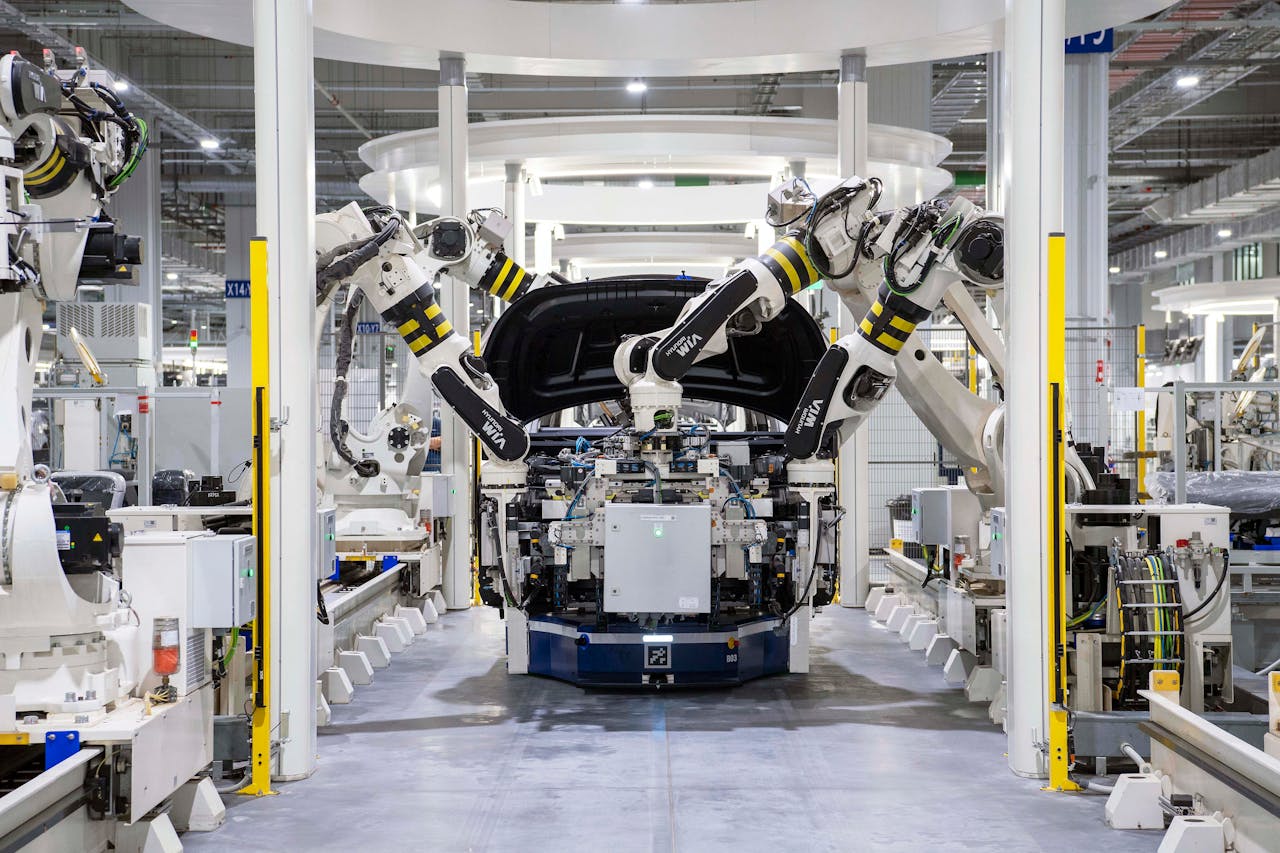


Sustainability in packaging is being redefined by AI, enabling you to reduce waste, optimize materials and extend product lifecycles through data-driven design and intelligent supply chains. By analyzing demand patterns and automating quality control, AI helps your operations lower carbon footprints and costs while improving recyclability and traceability. This shift gives you actionable insights to make smarter, measurable sustainability decisions across the packaging lifecycle.

Key Takeaways:
- AI-driven design and material optimization minimize waste and resource use by enabling lightweighting, selecting sustainable substrates, and accelerating lifecycle assessments.
- Intelligent manufacturing and supply-chain analytics improve efficiency through predictive maintenance, computer-vision quality control, and demand forecasting, reducing overproduction and emissions.
- Smart, connected packaging supports circularity with track-and-trace, IoT-enabled sorting and recycling, and consumer engagement that facilitates reuse and closed-loop systems.

AI landscape in packaging
Core AI technologies transforming packaging (ML, computer vision, IoT, edge AI)
You see ML driving generative packaging design and demand forecasting, computer vision catching defects at high speeds (1,000+ ppm) for inline quality control, IoT sensors streaming temperature, vibration and throughput data, and edge AI (NVIDIA Jetson, Siemens Industrial Edge) running on-site inference to eliminate latency-together enabling autonomous inspection, adaptive changeovers and reductions in scrap and downtime.
Market adoption, drivers and strategic priorities for industry players
You should focus pilots on measurable ROI: over 50% of packaging firms now run AI pilots for quality, predictive maintenance or design optimization, driven by rising material costs, tighter regulation and consumer sustainability demand. Strategic priorities are integrating AI with MES/ERP, upskilling operators, and forming vendor partnerships to scale line-level wins to enterprise deployments.
When you scale, expect obstacles like data silos and legacy PLCs; tier‑1 CPGs such as Nestlé and PepsiCo partner with vendors to accelerate rollout. You can target 10-30% faster changeovers or 5-15% material savings depending on process, and capturing that value typically requires cross-functional teams, clear KPIs and a cloud‑plus‑edge architecture to achieve payback in 6-18 months.
AI-enabled sustainable packaging design
You can use AI to balance performance and sustainability by rapidly testing thousands of material and structural permutations; tools that analyze supply-chain emissions and recyclability accelerate decisions, as discussed in this AI in Packaging briefing. Practical deployments cut iteration time from months to days while revealing trade-offs between cost, weight, and end-of-life impacts so your designs are evaluable across real-world constraints.
Material optimization and lightweighting through generative design
You can apply generative design and topology optimization to remove unnecessary material-using lattice infills, variable-thickness walls, or tuned corrugation patterns-to achieve typical material reductions of 20-30% in prototype projects. For example, replacing a polymer tray with an AI-optimized fiber geometry retained stiffness while lowering material use and cost, and rapid simulation lets you validate drop, vibration, and compression performance before physical prototyping.
Lifecycle modeling, recyclability assessment and circularity improvements
You should integrate AI-driven life-cycle assessment (LCA) with recyclability scoring to compare scenarios-like mono-material conversion or increased recycled content-across metrics such as CO2e, energy, and end-of-life value recovery. AI can flag hotspots (raw fiber, coatings, adhesives) and prioritize changes that most improve circularity, enabling you to meet regulatory targets and brand sustainability goals faster.
In practice, you run scenario ensembles-thousands of supply-chain permutations-so AI pinpoints where a 10-30% shift to recycled content yields the biggest emissions drop, or where a coating swap increases recyclability without sacrificing barrier performance. Machine vision and digital watermarking pilots have raised correct-sort rates by double-digit percentage points in sorting trials, and reinforcement-learning agents can sequence processing changes that maximize recovered material value while maintaining shelf-life and transport metrics. Using these tools, you can quantify trade-offs, project cost impacts over 3-5 years, and create actionable roadmaps to shift packaging toward verified circularity.
Intelligent manufacturing and quality control
AI-driven sensors, digital twins and closed-loop analytics let you detect process drift in real time, prioritize fixes and shorten validation cycles; companies like Nestlé and Colgate-Palmolive are already piloting these approaches – see 5 ways AI is shaping packaging today – resulting in up to 30% less unplanned downtime and faster R&D-to-production handoffs.
Predictive maintenance, process optimization and energy efficiency
By combining vibration, acoustic and thermal sensors with ML you can move to condition-based maintenance that predicts failures hours or days ahead, reducing emergency repairs. Models also optimize line speeds, motor loads and steam cycles so you lower energy per unit; many plants report 10-20% energy savings and significant reductions in maintenance cost with anomaly detection and reinforcement-learning schedules.
Automated inspection, defect detection and yield improvement
Vision and hyperspectral systems let you inspect labels, seals and fill levels at thousands of units per minute, so you catch micro-scratches, misprints and contaminants earlier. Integrating CNNs and edge inference reduces false rejects and can lift yield 5-10%, while speeding up root-cause analysis when defect clusters appear.
Deploying multispectral cameras with deep learning gives you material-specific detection-seal integrity via thermal profiling, contaminant ID by spectral signature and OCR tuned for blurred prints. Transfer learning reduces training time and active learning lets operators label edge cases in production. In deployment, high-speed lines using these stacks often achieve >95% detection precision, cut manual inspection hours and improve traceability for targeted recalls.
Supply chain and logistics intelligence
AI stitches together sensor data, ERP feeds and logistics telemetry so you get end-to-end visibility and actionable alerts. Using RFID, IoT and cloud analytics, manufacturers and packagers detect anomalies in transit, trigger emergency reroutes, and reduce spoilage-some pilots report 15-30% lower waste. You can also use digital twins to simulate disruptions and shorten lead times, improving resilience during peak seasons like holidays or product launches.
Demand forecasting, inventory optimization and waste reduction
Demand sensing models ingest POS scans, promotions, weather and social signals so you adjust production at SKU level within days instead of weeks. You can boost forecast accuracy by 10-30% and cut safety stock 15-25%, lowering expired inventory and markdowns. Case studies from CPG brands show AI-driven reorder triggers reduced stockouts while cutting per-SKU waste, enabling more sustainable packaging batch sizes and fewer emergency shipments.
Route optimization, cold‑chain monitoring and reverse logistics
Dynamic route optimization uses telematics, traffic feeds and delivery constraints to trim miles, time and emissions; pilots typically see 10-20% cost reductions. You can pair real‑time cold‑chain telemetry-continuous temperature logs, GPS and predictive alerts-to prevent spoilage in perishable shipments. AI also automates reverse-logistics decisions, routing returns to refurbishment, donation or recycling centers to cut disposal rates and recover value from packaging materials.
Tactics include integrating dynamic vehicle‑routing algorithms (VRP with time windows), load consolidation, and multimodal switching so you reduce empty miles and packaging idling. When you combine edge AI in trucks with cloud ML models, predictions for ETA and temperature excursions improve, enabling proactive transfers to refrigerated hubs. Operators using these techniques have reported 5-15% improvements in on‑time performance and significant drops in cold‑chain breaches, increasing packaging reuse and lowering carbon intensity per shipment.
Consumer-facing intelligence and traceability
You can give buyers instant trust and product context by combining QR/NFC codes, AR overlays and blockchain-backed records; for example, Walmart’s IBM Food Trust pilots cut produce trace times from days to about 2.2 seconds, proving tangible ROI for digital traceability. Integrate on-pack links to further reading like The Future of Packaging: How AI Is Driving Innovation – CMI to drive engagement and measurable post-purchase interactions.
Smart labels, dynamic packaging and personalized experiences
You can use NFC tags, QR codes and e-ink or color-changing inks to update freshness, dosage or promotions in real time; Nestlé and Mondelez pilots have used smart labels to A/B test pack messaging and increase repeat purchases by targeted segments. Augmented reality overlays let you deliver recipes, sourcing videos or loyalty offers the moment a consumer scans, turning static packaging into a personalized digital touchpoint.
Anti‑counterfeiting, provenance tracking and regulatory compliance
You should deploy item-level serialization, blockchain anchors and machine-readable identifiers so consumers verify authenticity instantly; luxury brands like LVMH use blockchain proofs to let buyers confirm provenance, while serialized codes satisfy pharma regulations such as the EU Falsified Medicines Directive. This combination deters fraud and gives you auditable records for audits and recalls.
Digging deeper, you can combine AI-based image recognition at point-of-sale with serialized identifiers to flag anomalies-pattern detection catches batch-level counterfeits faster than manual inspection. Standards like GS1 Digital Link let you map IDs to trace data, and regulators increasingly expect serialization: implementing end-to-end trace systems has reduced recall scopes in pilot programs and shortened investigation times from weeks to days, minimizing liability and waste.
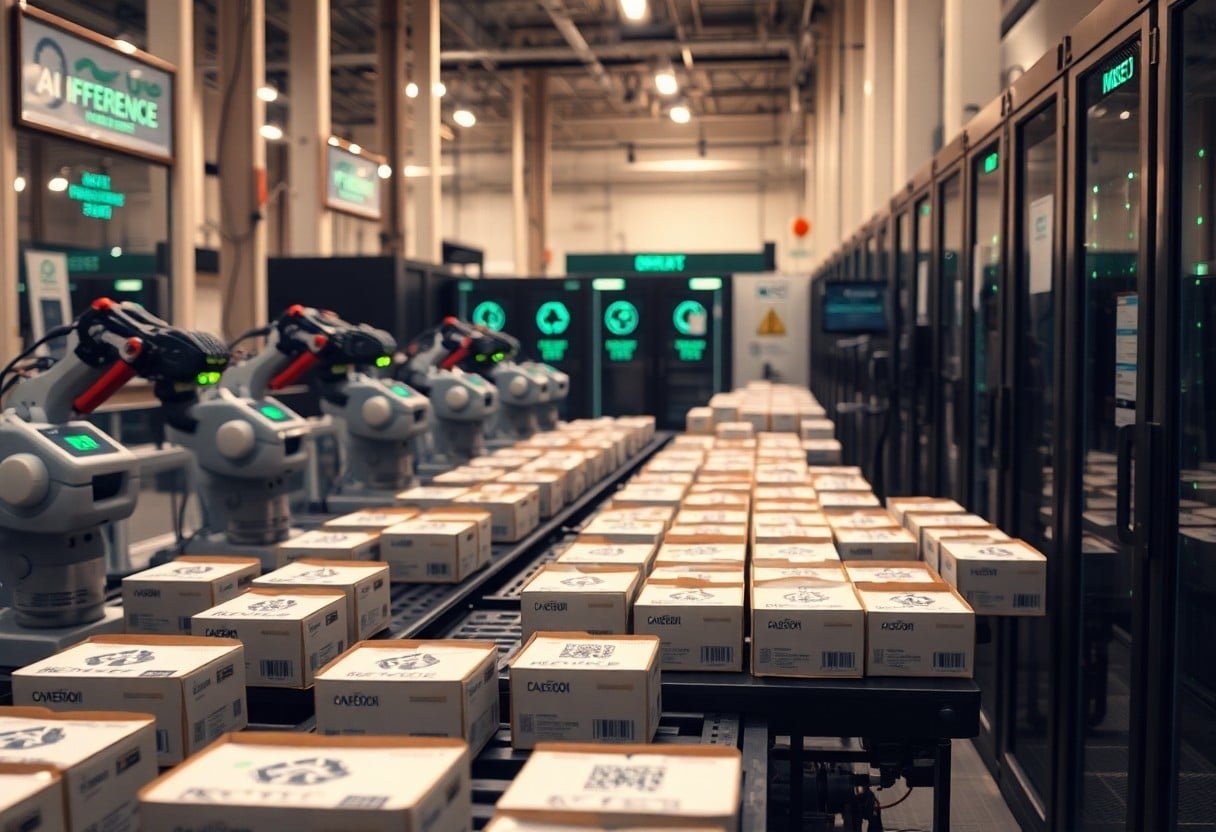
Risks, governance and scaling AI in packaging
You must treat governance as operational: align AI pilots with standards like ISO/IEC 27001 for security and ISO 14001 for environmental management, map regulatory baselines such as the EU AI Act’s four risk tiers, and factor in producer-responsibility rules (EPR present in 30+ jurisdictions) when scaling. Practical steps include formalizing data contracts, budgeting for third‑party conformity assessments, and running staged rollouts from pilot to plant floor to avoid governance gaps that turn efficiency gains into compliance or reputational losses.
Data governance, interoperability and workforce readiness
You need canonical product and packaging identifiers (GS1 Digital Link), API‑first architectures, and master‑data management to prevent fragmentation between designers, converters, and retailers. Implement role‑based access, encryption, and auditable data lineage; adopt EDI or OPC UA where plant automation is involved. For skills, run 3-6 month upskilling bootcamps, pair data scientists with line engineers, and create cross‑functional playbooks so your teams can operationalize models without creating bottlenecks.
Ethical, regulatory and environmental risk management
You should mitigate model bias, false positives in quality inspection, and unintended material substitutions by documenting datasets (datasheets/model cards), enforcing explainability, and applying lifecycle assessment (LCA) during optimization. Follow conformity workflows under the EU AI Act for high‑risk systems, ensure traceability for EPR reporting, and schedule third‑party audits so regulatory, ethical, and environmental risks are addressed before wider deployment.
You can operationalize risk controls by establishing a model governance loop: perform a pre‑deployment impact assessment, log training data provenance, and require explainability targets (e.g., SHAP or LIME reports) for decisioning models; deploy drift detection and automated alerts that trigger retraining or human review when performance deviates beyond defined thresholds. Integrate LCA tools into your optimization pipeline to quantify trade‑offs (material reduction versus recyclability), maintain EPDs for packaging SKUs, and use independent conformity assessments for EU AI Act compliance-this combination prevents wasteful recalls, supports EPR reporting, and keeps your AI deployments auditable and defensible.
Final Words
So you can leverage AI-driven design, smart materials, and predictive logistics to reduce waste, lower emissions, and extend product lifecycles, while automating quality control and customizing packaging at scale. By adopting these technologies you steer your operations toward measurable sustainability goals and resilient supply chains, ensuring regulatory compliance and consumer trust as you build a more intelligent, efficient packaging future.