

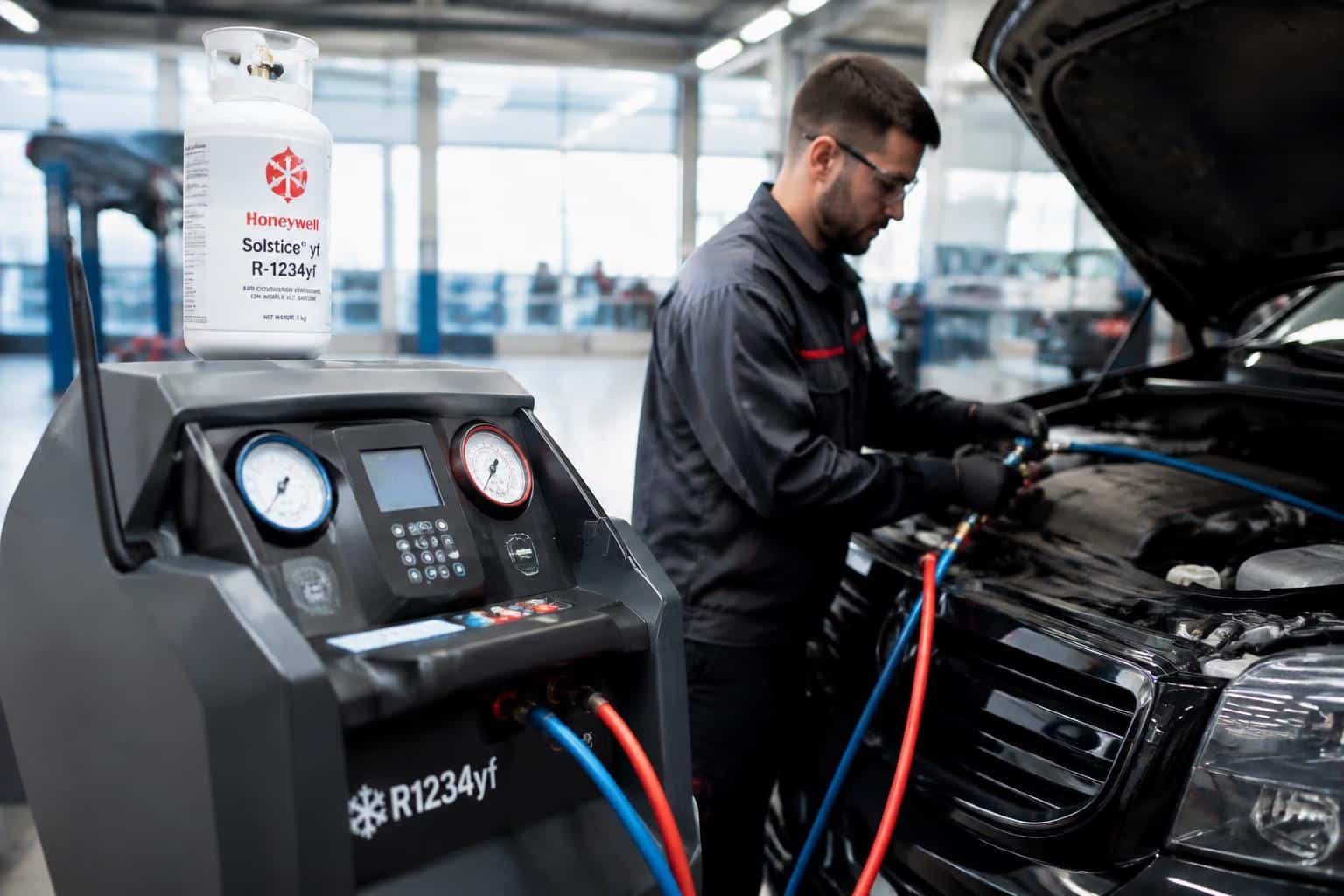
Your vehicle’s air conditioner depends on refrigerant, and federal rules now govern the production and use of many hydrofluorocarbons (HFCs) used in cooling systems. The EPA’s AIM Act phases down HFC supplies and sets requirements for certain refrigerants and equipment. For mobile air conditioning, the practical effect depends on the refrigerant specified for your vehicle, such as R-134a or R-1234yf.
Key Takeaways:
- The AIM Act phases down hydrofluorocarbons (HFCs), including R-134a, which has long been used in vehicle air-conditioning systems. The transition also affects refrigerant supplies and the servicing equipment used by automotive technicians.
- Newer vehicles increasingly use lower-global-warming-potential refrigerants, such as R-1234yf. Because refrigerants require compatible service fittings and equipment, technicians must identify the refrigerant specified for each vehicle before connecting recovery or charging equipment.
- The phase-down does not make existing vehicle systems using R-134a illegal to service. Technicians can continue servicing them with the correct refrigerant and equipment, while recovery and proper handling remain part of routine automotive AC work.
The AIM Act and HFC Phasedown
For your understanding of the rules, the AIM Act sets a nationwide framework for reducing hydrofluorocarbons, or HFCs, because of their high global warming potential. Its phasedown applies across covered substances and sectors, shaping how HFCs are produced, imported, exported, and used. The Environmental Protection Agency administers the law through regulations that define covered chemicals, allocate allowances, and establish restrictions. The schedule is measured against historical HFC production and consumption levels, rather than a single product category.
AIM Act authority and implementation
Congress gave the EPA authority under the American Innovation and Manufacturing Act of 2020 to phase down HFCs and regulate their management. The agency implements that mandate through rules addressing production and consumption allowances, restrictions on specific uses, and practices for reclaiming and reporting regulated substances. For you, the distinction matters: the statute establishes the broad framework, while EPA regulations set operational requirements and identify which HFCs and activities fall within each program.
HFC production and consumption limits
Under the statutory schedule, you can track the phasedown against a baseline set at 100 percent, with the allowable level declining to 15 percent beginning in 2036. The EPA uses an allowance system to limit production and consumption, assigning allowances to regulated entities; consumption is calculated from production plus imports, minus exports and destruction. These limits apply to covered HFCs as a group, with each chemical weighted by its global warming potential.
Effects on Mobile Air Conditioning
For vehicle air conditioning, the AIM Act’s HFC phasedown influences which refrigerants manufacturers use in new systems, rather than requiring every existing vehicle to switch refrigerants. As supplies and regulatory limits change, automakers increasingly specify alternatives with lower global warming potential. The resulting refrigerant mix varies by vehicle model and production year, so a system’s under-hood label identifies its intended refrigerant, such as R-134a or HFO-1234yf. New EPA Regulations on Air Conditioning Refrigerants provides related discussion.
R-134a and HFO-1234yf
R-134a has long been used in passenger-vehicle air conditioning, but its high global warming potential places it within the HFC phasedown. HFO-1234yf, a lower-global-warming-potential refrigerant, became a common alternative in newer light-duty vehicles. You should not treat the two as interchangeable: they have different system specifications and require refrigerant-specific components. A vehicle’s refrigerant label identifies the correct type, while the service fittings are designed for that system.
New vehicles and refrigerant transitions
Automakers determine refrigerant selection as they design and certify new vehicle models, with the transition occurring across model lines rather than through a single fleet-wide changeover. Newer light-duty vehicles commonly use HFO-1234yf, while older models often retain R-134a systems. For you as a vehicle owner, the practical effect is that refrigerant choice depends on the car’s original design, not simply its age or the date you purchase it. The under-hood label specifies the designated refrigerant.
Servicing and Repair Requirements
In a service bay, your refrigerant handling duties depend on the vehicle’s system and the refrigerant specified by its manufacturer. EPA rules require technicians servicing motor vehicle air conditioners to use approved recovery or recycling equipment and follow applicable handling procedures. You must prevent refrigerant releases during service, use equipment suited to the refrigerant in the system, and keep recovered material out of the atmosphere. The service label identifies the refrigerant type and charge information.
Refrigerant recovery, recycling, and reclamation
Before opening an air-conditioning circuit, you use a recovery or recovery-and-recycling machine approved for the refrigerant being serviced. Recovered refrigerant must not be vented; recycling equipment removes contaminants for reuse in the same owner’s vehicle, while refrigerant intended for use in another vehicle generally must be reclaimed to the applicable purity standard. Keep refrigerants separated by type, since mixing HFC-134a with HFO-1234yf can contaminate the supply and complicate safe servicing.
Leak repair and service practices
During a repair, you locate leaks with an appropriate detector or approved diagnostic method, then repair the source before recharging the system. Do not use refrigerant as a leak-test gas or knowingly release it while disconnecting hoses; recover the charge first and minimize losses when connecting service equipment. Follow the vehicle maker’s procedures for components such as compressors and condensers, and recharge by the specified mass using the refrigerant identified on the under-hood label.
Compliance, Costs, and Industry Impacts
For automakers, suppliers, and repair shops, the AIM Act’s refrigerant rules add compliance work across vehicle design, parts sourcing, and service operations. Your costs depend on the refrigerant used, equipment already on hand, and the timing of product or shop upgrades. Automakers must coordinate with component suppliers on compliant systems, while service businesses need procedures for handling refrigerants and maintaining required records. EPA’s Issue 349: EPA Finalizes Rule on Refrigerant Regulations outlines the regulatory framework.
Equipment, training, and supply considerations
Shop owners need refrigerant identifiers, compatible recovery and recycling machines, and dedicated cylinders when servicing vehicles that use different refrigerants. Your existing equipment may not be approved for a new refrigerant, so capital expenses can include replacement machines, fittings, and leak-detection tools. Technicians also need training on safe handling and equipment procedures. Automakers and suppliers face parallel planning demands, including sourcing compliant refrigerant and redesigning components such as compressors, hoses, and service ports.
Regulatory obligations and enforcement
Repair businesses must follow EPA requirements that apply to refrigerant handling, including using certified technicians and approved recovery equipment where required. Your shop should retain service and refrigerant records in the form and manner applicable to its work, and prevent intentional venting during maintenance. Automakers and suppliers must meet applicable restrictions and reporting obligations for covered products and substances. EPA enforcement can include inspections and penalties for violations, making accurate service logs and equipment records practical evidence of compliance.
What Vehicle Owners May Notice
Your experience may depend on the refrigerant specified for your vehicle, local parts supply, and the equipment a repair shop has available. Routine air-conditioning work, such as diagnosing a leak or recharging a system, can take longer if a shop needs to source the correct refrigerant or fittings. Costs also vary with the vehicle’s system design and the repair required, rather than following a single price change across all vehicles.
Refrigerant availability and pricing
Supply and pricing can differ by refrigerant type, region, and season, so a recharge for one vehicle may not cost the same as service for another. Your technician should identify the refrigerant listed on the under-hood label before opening the system, since refrigerants and service fittings are not interchangeable. Broader limits on hydrofluorocarbons can affect supply chains; see the report on EPA sets stricter limits on hydrofluorocarbons used in refrigerators and air conditioners.
Choosing qualified service providers
Look for a shop with technicians trained to service your vehicle’s specified refrigerant and with dedicated recovery and charging equipment. Proper identification, leak testing, and refrigerant recovery reduce the risk of contamination or an incomplete repair. Ask whether the estimate includes diagnosis, leak repair, and the refrigerant charge, because those are separate labor and materials items. For a vehicle using R-1234yf, the shop needs compatible service equipment and fittings, not an adapted R-134a setup.
Future Outlook for Mobile AC Regulation
As the HFC phasedown continues, refrigerant choices for new vehicles and service equipment will increasingly reflect both climate impact and practical performance. You may see manufacturers favor refrigerants with lower global warming potential, while automakers, suppliers, and repair professionals adapt components and procedures to those choices. The pace of change will depend on vehicle design cycles and federal rules, so the mobile AC market is likely to evolve through successive model generations rather than a single industry-wide switch.
Emerging refrigerants and technologies
R-1234yf is already used in many newer vehicles as a lower-global-warming-potential alternative to R-134a, and carbon dioxide, known as R-744, remains another option for mobile AC systems. If your vehicle uses a newer refrigerant, its compressor, seals, service fittings, and recovery equipment must match that system. Automakers also continue refining heat-pump and thermal-management designs, which can integrate cabin cooling with battery temperature control in electric vehicles.
Potential regulatory changes
Future EPA rules could further shape which refrigerants manufacturers use by setting or revising limits on the global warming potential of substances in new equipment. You may also see updated requirements for refrigerant labeling, equipment standards, or technician practices as lower-impact products enter wider use. Any changes will depend on rulemaking and statutory authority, rather than the phasedown alone, so the specific refrigerants permitted in future vehicle models will be determined by the regulations in effect when those models are designed.
Summing up
The AIM Act changes mobile air conditioning through a phasedown of hydrofluorocarbon refrigerants, including HFC-134a, and tighter controls on refrigerant handling. For you as a vehicle owner, the practical effects depend on your car’s model year, refrigerant type, and service needs. A qualified technician must use equipment designed for the specified refrigerant and follow leak repair and recovery requirements. Before service, identify the refrigerant listed on your vehicle’s under-hood label.