
Many dealerships will see AI-driven tools transform how you connect with buyers, price vehicles, and manage inventory by 2026. You’ll benefit from personalized marketing, predictive maintenance alerts, virtual showrooms, and automated finance workflows that streamline operations, sharpen margins, and let your staff focus on building trust and closing deals with more informed customers.
Key Takeaways:
- AI enables hyper-personalized customer journeys across digital and in-store channels, improving lead conversion and lifetime value while transforming the showroom into an experience and fulfillment center.
- Predictive pricing, demand forecasting, and inventory optimization reduce days-on-lot and increase margin through dynamic stocking and targeted promotions.
- Dealers will need new tech skills, data governance, and partnerships with OEMs and platforms as business models shift toward digital retailing, subscriptions, and service-led revenue.
The 2026 market landscape
By 2026 you’ll be navigating a market where EVs have pushed into double-digit new‑car share, software-defined vehicles reshape ownership economics, and AI-driven personalization governs shopping funnels. Dealers face shrinking new-vehicle margins but growing service and subscription revenue opportunities, while digital marketplaces and OEM direct-sales pilots force faster adoption of omnichannel retail, remote financing, and contactless delivery to keep pace with evolving buyer expectations.
Shifting consumer expectations and buying behaviors
You now encounter buyers who begin 90% of their journeys online, expect instant, transparent pricing, and want options like at-home test drives and same-day delivery. Examples from Carvana and Tesla show how frictionless financing, live configurators, and mobile service raise the bar; if your process still requires multiple showroom visits, you’re likely losing conversion to competitors offering end-to-end digital experiences.
OEM strategies and competitive pressures
OEMs are doubling down on software, subscriptions, and direct sales to capture recurring revenue and data-Tesla monetizes features via OTA purchases, Volvo and Porsche trial subscriptions for features, and Volkswagen’s CARIAD unit centralizes software development. As a dealer, you must adapt to OEMs shifting some sales and service touchpoints online while negotiating your role around delivery, warranty work, and localized customer experience.
Digging deeper, you’ll see OEM investments translate into concrete channel changes: some brands now require dealer networks to support online-initiated sales and home delivery logistics, while others pilot capped dealership footprints to favor branded retail hubs. Expect more OEM mandates on pricing transparency and digital lead routing; simultaneously, new entrants like Rivian and BYD push factory-direct elements that compress traditional margins. To stay relevant you should quantify per-unit service potential, negotiate lead-sharing terms, and build AI tools that convert OEM-generated leads into profitable, personalized showroom or at-home experiences.
AI-powered sales & marketing
AI turns scattershot outreach into targeted conversations: you can automate personalized offers, score leads by purchase intent, and surface upsell opportunities in real time. Pilot programs report 20-35% lift in lead-to-sale conversion and shorter sales cycles, while integrations with your DMS and CRM let models act on VIN-level history, service records, and local market signals to prioritize the highest-value interactions.
Hyper-personalized outreach and intelligent lead scoring
AI analyzes browsing sessions, past purchases, and service visits to craft messages that feel bespoke-dynamic emails, individualized finance offers, and tailored trade valuations. You’ll see lead scores rise in accuracy using models trained on your data (conversion-weighted scores), so sales reps focus on leads with predicted close probabilities rather than arbitrary age or source labels; some dealers report a 30% improvement in rep productivity.
Dynamic pricing, bundling, and inventory matching
Real-time repricing engines ingest competitor listings, local demand, seasonality, and floorplan cost to set optimal prices and recommend bundles (warranty, maintenance, accessories) that preserve margin while improving turn. When you apply elasticity models and OEM incentive constraints, tests show 1-3% margin gains and 10-15% faster days-to-sale on aging stock.
Deeper implementation ties inventory-matching algorithms to your lot and digital channels: you’ll get AI-suggested trades, VIN-level merchandising, and site-specific promotions that move slow SKUs. Practical examples include auto groups that used demand-weighted matching to cut aging units by ~18% and tools that automatically create profit-positive bundles-balancing manufacturer rules, F&I products, and local competitor gaps to maximize both velocity and per-deal EBIT.
Service, parts & aftermarket
AI stitches service, parts and aftermarket into a single operational loop so you can predict demand, reserve bays and pre-order parts before customers arrive. For practical workflow examples see How AI Agents Will Reshape Every Dealership Workflow. In pilots, dealers raised bay utilization from typical 60-70% toward about 80% by aligning tech schedules with AI forecasts.
Predictive maintenance and proactive scheduling
By combining telematics, service history and VIN-level alerts, AI flags vehicles likely to need attention 7-30 days ahead so you can contact owners and reserve the right technician. You can cut unscheduled breakdowns in pilot programs by roughly 20-30%, improve same-day capacity and turn a reactive shop into a retention engine with timely outreach.
Parts forecasting and automated fulfillment
AI forecasts SKU-level demand using POS, repair orders and supplier lead times so you can set dynamic safety stock and trigger automated reorders or local marketplace fulfillment. You’ll reduce stockouts and often achieve fill rates above 85% for common parts, enabling same-day or next-day deliveries that keep service appointments on schedule.
Models ingest seasonality, campaign spikes, technician usage rates and warranty trends while integrating with your DMS and supplier APIs to optimize reorder points and minimize carrying cost. Case studies show dealerships cutting inventory carrying costs by 10-15% while pushing fill rates above 90% for core SKUs, freeing cash and shortening repair turnaround times.
Dealership operations & customer experience
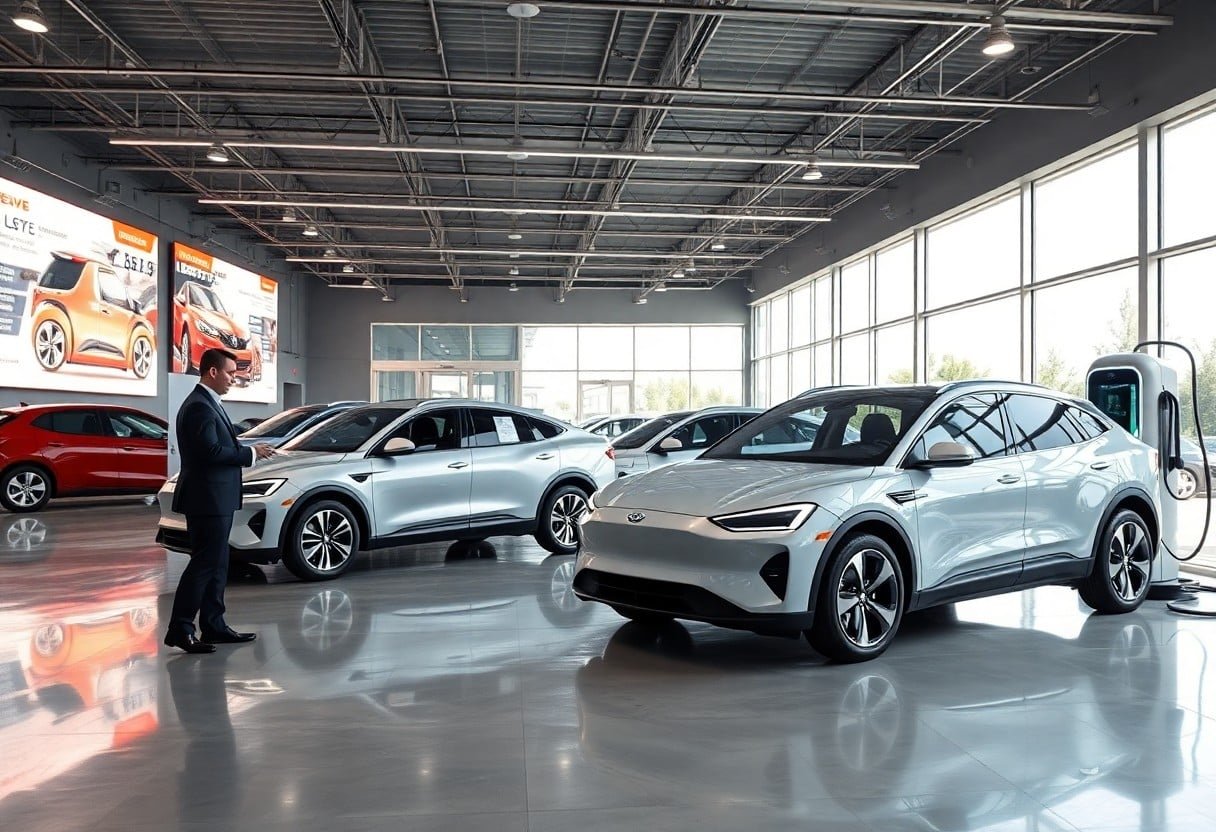
You’ll notice AI shaving hours off admin work while personalizing outreach: chatbots qualify leads 24/7, service-predictive models cut no-shows, and pilot programs report 15-25% lifts in conversion. By tying inventory, CRM and service data you create consistent handoffs and faster closes; see one dealer playbook at The formula to selling more cars: How to make AI work for …. Expect measurable KPI improvements within months as teams adopt automation and analytics.
In-store automation and digital retail tools
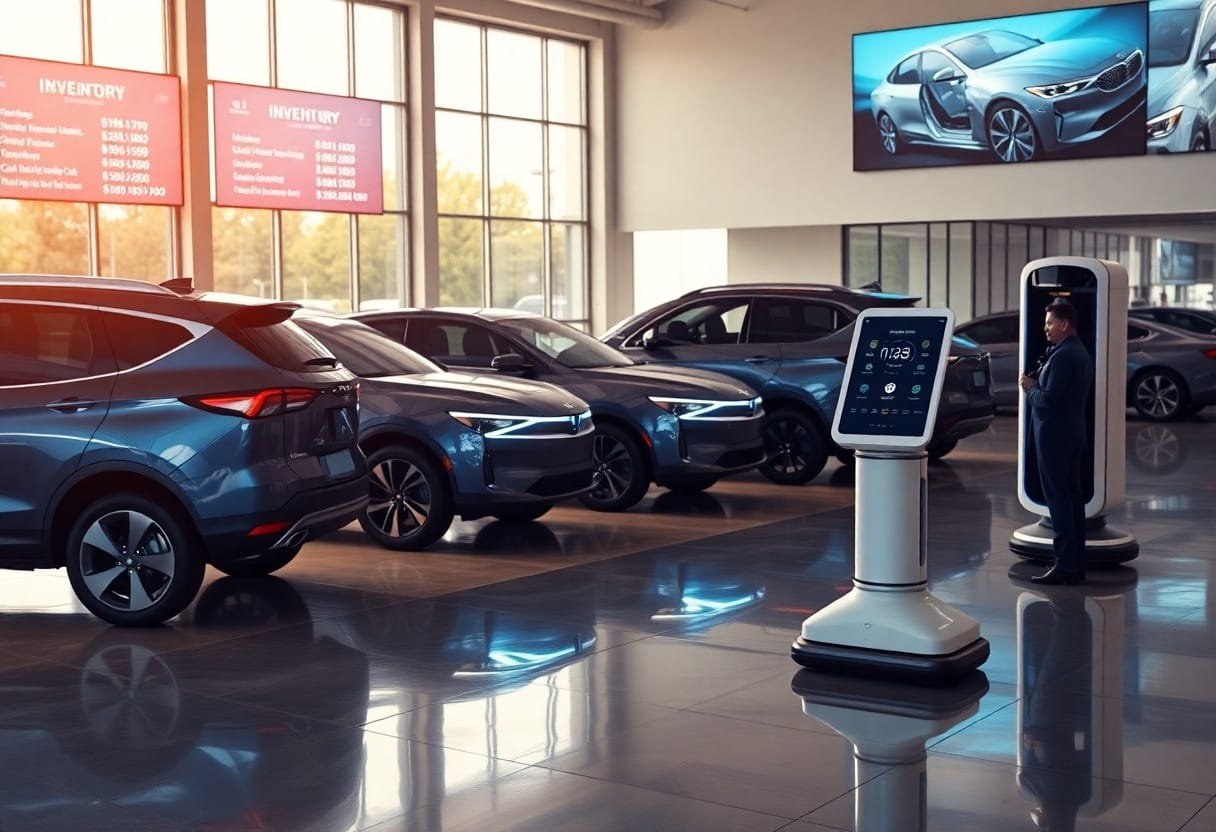
In the showroom, tablet-guided walkarounds, e-contracting and integrated F&I let you finish deals in under an hour: dealerships using e-signatures report 30-40% shorter transaction times. Retail kiosks and real-time credit checks remove friction, while DMS integrations push accurate deals to service and accounting instantly, cutting reconciliation headaches and improving gross per sale.
Seamless omnichannel journeys
Customers move between web, mobile and showroom expecting continuity, so you must stitch behavior and intent into a single profile; industry surveys show buyers often research online before visiting, and persistent quotes or saved finance pre-approvals boost conversion. Omnichannel orchestration means your sales rep sees the same cart, test-drive request and trade valuation the customer had on their phone.
For more depth: implement real-time lead routing that matches intent (price, model, trade) to the right rep, enable persistent carts that hold vehicles and offers across devices, and offer click-to-schedule test drives with instant confirmations. One regional group that layered CRM-driven messaging with online finance approvals saw showroom-visits-to-sales conversion rise ~18% in six months; you can replicate that by aligning incentives, standardizing data fields and instrumenting every touch for optimization.
Workforce transformation
You’ll see roles shift from routine admin to AI-enabled decision support, freeing your team for higher-value customer work and technical diagnostics; early adopters report administrative time reclaimed equivalent to a full headcount per 50 salespeople, and dealer groups that invested in reskilling saw service bay productivity rise within six months.
New roles, skills, and training programs
You’ll hire AI-Service Managers, Digital Inventory Analysts, and Sales Data Specialists while upskilling technicians on over-the-air diagnostics and predictive maintenance; many dealers run 6-12 week bootcamps, partner with community colleges or vendors for certifications (AWS/GCP), and one regional group retrained 120 staff in a 10-week program, cutting average diagnostic time by about 30%.
Adoption, change management, and culture
You’ll need a pilot-led rollout, visible executive sponsorship, and measurable KPIs-lead response time, time-to-delivery, and upsell rate-to drive adoption; pilots of AI tools in 10-20 stores let teams iterate UI, SOPs, and incentive plans before scaling across a 12-18 month roadmap.
You’ll accelerate buy-in by staffing mixed teams of early adopters and frontline reps, running weekly feedback sprints and tying a portion of compensation to measured AI-driven outcomes; combining a 90-day pilot cadence, hands-on shadowing, and a dedicated support desk typically halves time-to-proficiency and surfaces process fixes before full deployment.
Financial and performance outlook
AI adoption shifts revenue mix-subscription services, F&I personalization, and used-vehicle pricing optimization can lift gross per unit (GPU) and shorten days-to-turn. Expect pilot programs to show 8-12% top-line lift and 3-6 percentage-point margin improvement when AI automates repricing and lead routing. You can explore implementation strategies in Your Guide to AI at NADA 2026: What to See, Why It …
Revenue models, cost impacts, and margins
You should model three revenue streams: SaaS/subscription for dealer tools, performance-based fees per sale, and data/insights monetization. Plan for vendors to price per rooftop ($100-$500/month) or per-vehicle ($1-10) depending on scale, and run scenarios showing how shifting fixed IT spend to variable fees affects EBITDA. Use sensitivity analyses to see how a 5% sales uplift translates to GPU and margin expansion across new and used lanes.
KPIs, ROI measurement, and risk management
Prioritize lead-to-sale conversion, GPU, F&I attach rate, inventory days-to-turn, and service retention as primary KPIs. Set baselines and target 15-25% faster lead response and 5-10% GPU uplift within six months. Use 30/90/365-day cohorts, holdout controls for attribution, and monitor model drift, bias, and compliance to mitigate operational risk.
You need tight measurement: run randomized A/B tests on pricing and messaging, tag cohorts by acquisition channel, and calculate CAC, LTV, and payback period monthly. Define governance cadence-weekly dashboards, monthly ROI reviews, and a stop-loss threshold (for example ROI under 2:1 after six months). Also enforce data lineage, model refresh schedules, and legal sign-offs before full rollout.
To wrap up
Upon reflecting, AI-driven automotive retail will shift how you connect, sell, and serve: personalized shopping journeys, predictive inventory and pricing, streamlined ops, and data-led marketing will let your dealership scale efficiency and customer satisfaction while redefining staff roles toward higher-value tasks. By embracing these tools you’ll compete more nimbly, adapt to changing demand, and create experiences customers prefer, positioning your business for stronger margins and growth through 2026.