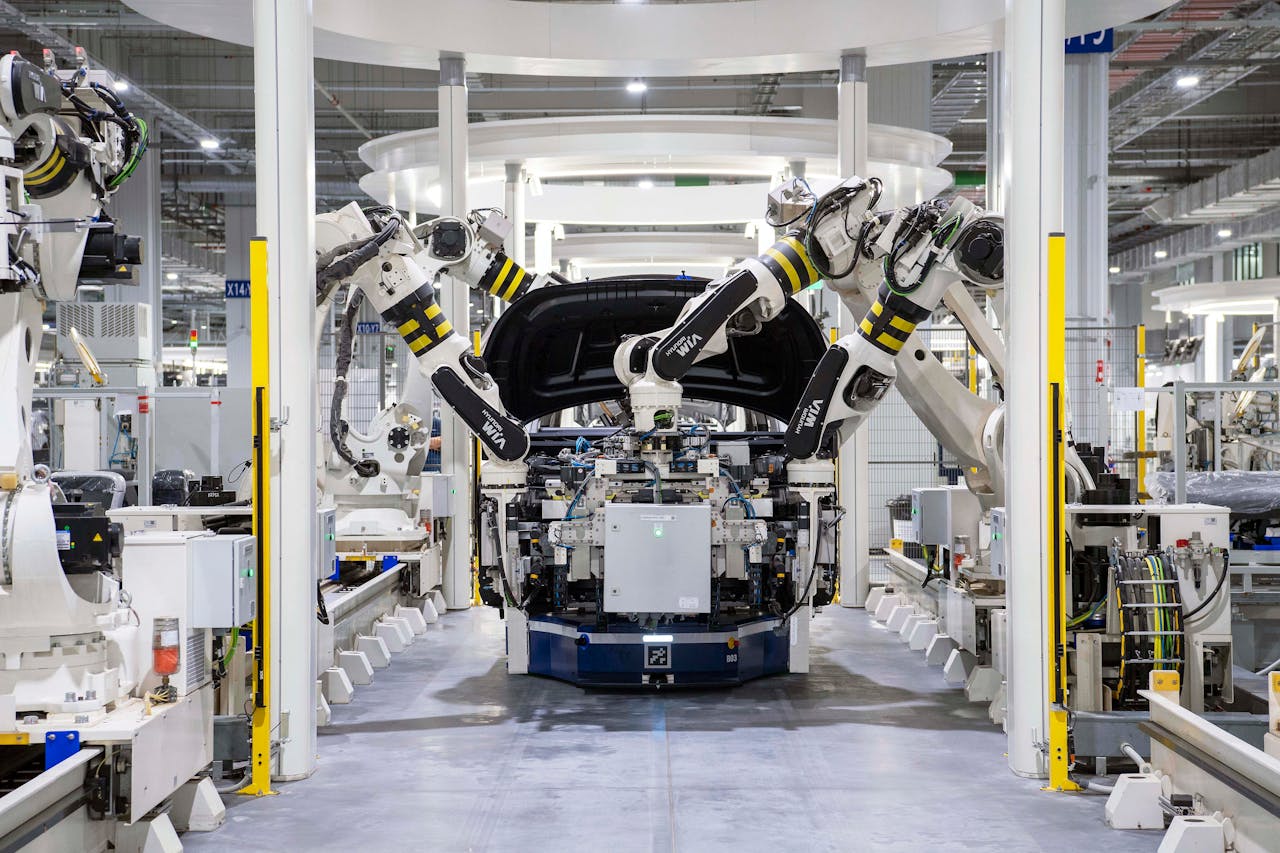

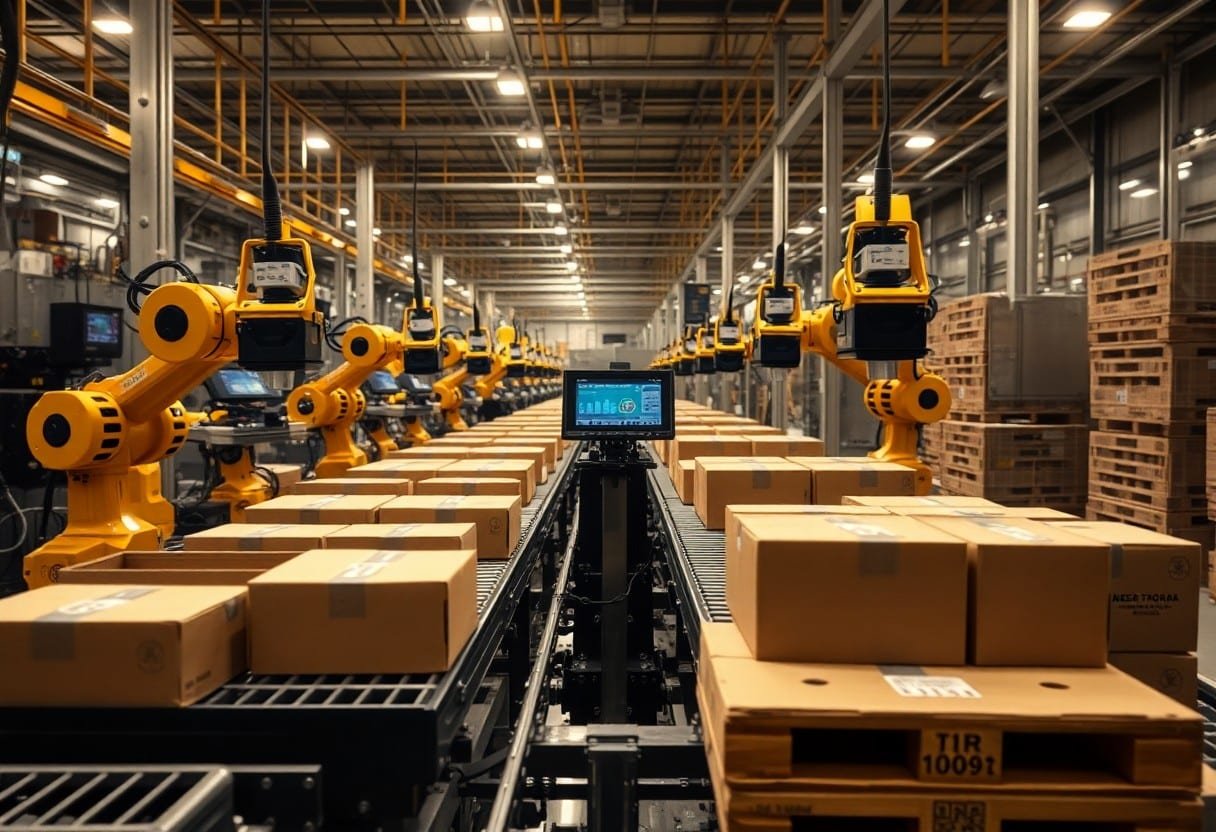
It’s time you understand how AI drives measurable gains across packaging operations: from predictive maintenance and automated quality inspection to dynamic line balancing, demand forecasting, robotic pick-and-place, and waste reduction-AI helps you cut costs, boost throughput, and improve consistency while freeing your team to focus on higher-value work, and this list reveals ten proven applications that deliver faster, smarter packaging performance.
Key Takeaways:
- AI-powered vision systems and collaborative robots automate inspection and packing, boosting throughput and reducing errors and labor dependency.
- Predictive maintenance and demand forecasting cut downtime and inventory waste by using sensor and sales data to schedule repairs and optimize stock levels.
- Generative design and supply-chain intelligence improve material usage and routing, lowering costs and environmental impact while enabling mass customization.
Predictive equipment maintenance
Using AI-driven predictive maintenance, you shift from scheduled checks to condition-based interventions, extending machine life and cutting repair costs. Models analyze sensor streams to forecast failures, prioritize work orders, and optimize spare parts inventory so your line keeps running smoother and leaner.
Minimizes unexpected downtime
AI detects subtle pattern changes before breakdowns, so you can plan repairs during low-impact windows and avoid sudden stoppages. By prioritizing interventions based on failure risk, your production uptime rises and emergency maintenance expenses fall.
IoT sensors with ML
Combining distributed IoT sensors with machine learning enables real-time health monitoring of motors, conveyors, and fill systems, delivering actionable alerts to your team and automating decision rules that keep lines stable.
Deploying vibration, temperature, pressure, and acoustic sensors at key points gives you high-fidelity data; ML models perform anomaly detection, predict remaining useful life, and correlate issues across equipment. You can run inference at the edge for low-latency alerts, sync aggregated data to the cloud for model retraining, and integrate outputs with your CMMS to automate maintenance scheduling and part ordering.

Automated visual inspections
You use AI-driven vision to inspect packaging at production speed, replacing slow manual checks with consistent, objective analysis that reduces errors and increases throughput; the systems flag anomalies, feed results to your control systems, and enable data-driven decisions to optimize yield and compliance.
Faster defect detection
AI lets you detect defects in milliseconds-surface blemishes, misprints, seal issues-and automatically prioritize or remove faulty items so you reduce rework, cut waste, and keep lines moving without manual bottlenecks.
Computer vision systems
Computer vision combines high-resolution cameras and deep learning so you can verify labeling, detect subtle defects, and assess package integrity in real time, adapting to new SKUs through incremental training and providing actionable analytics for your operations.
More specifically, you can deploy 2D/3D imaging, multispectral sensors, and edge inference to capture diverse defect signatures; models use transfer learning, synthetic augmentation, and continuous feedback to improve accuracy while integrating with PLCs and MES to trigger instant corrections and maintain traceability across your workflow.
Robotic pick-and-place
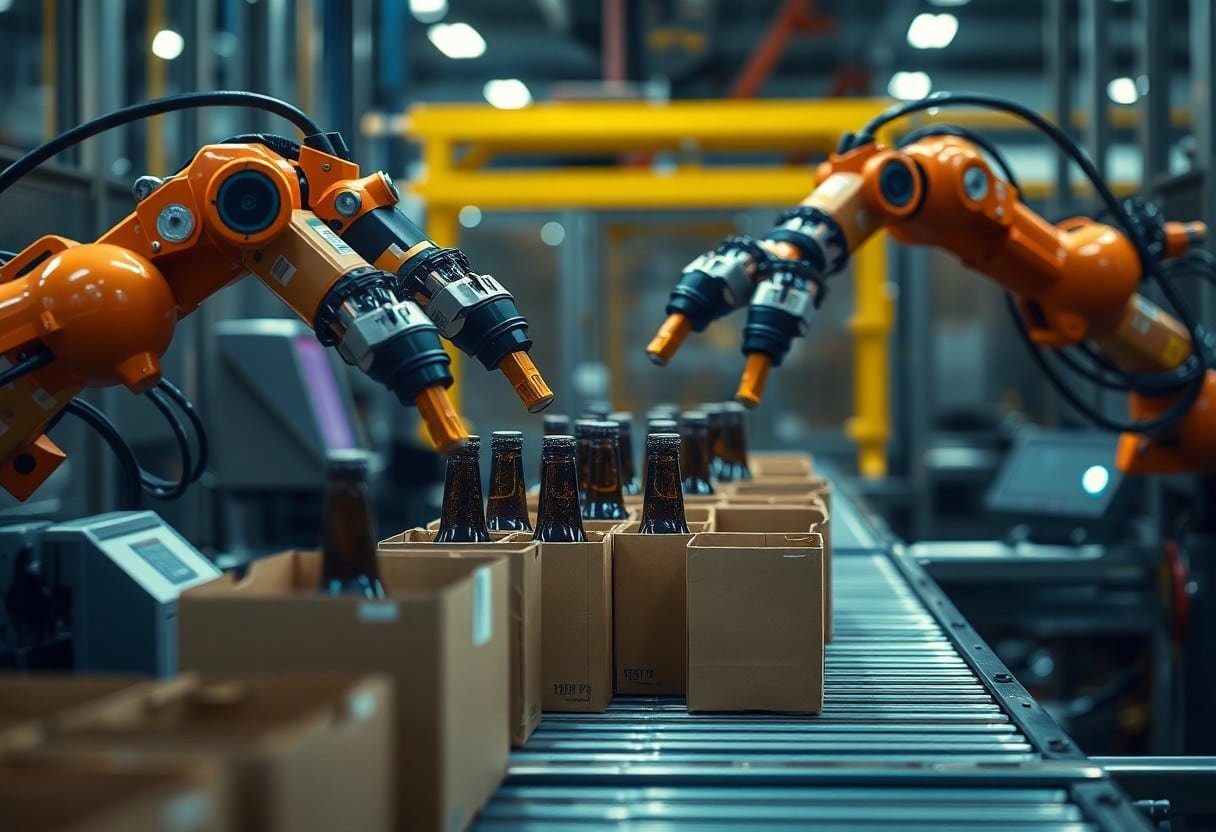
Robotic pick-and-place systems combine AI vision, motion planning and adaptive gripping so you increase speed and accuracy across varied packaging lines; you can reduce downtime and scale operations efficiently – see industry examples in 10 Artificial Intelligence Innovations Impacting the ….
Higher throughput rates
AI-driven scheduling, path optimization and real-time error correction let you run continuous pick-and-place cycles at higher speeds, improving conveyor utilization and lowering cycle times while maintaining product integrity and consistency.
Collaborative robots (cobots)
Cobots enable you to place robots alongside operators safely, offloading repetitive pick-and-place tasks so your staff can focus on inspection and exception handling, which raises overall line productivity and workforce utilization.
With force-limited joints, easy teaching interfaces and compact footprints, cobots allow you to deploy quickly on existing lines without heavy safety retrofits; you can perform fast changeovers, scale for demand and realize rapid ROI through reduced handling errors and labor reallocation.
Supply chain optimization
AI transforms your supply chain by combining demand forecasting, inventory optimization, and supplier risk scoring to reduce stockouts and excess inventory. Machine learning analyzes sales signals, seasonality, and external factors so you can plan production, allocate resources, and respond faster to disruptions while lowering costs and improving service levels.
Reduced lead times
AI shortens your lead times through predictive demand planning, automated procurement, and dynamic scheduling that align production with real-time orders. By automating replenishment triggers and optimizing batch sizes, you can cut wait times, accelerate order fulfillment, and improve throughput across suppliers and warehouses.
Real-time logistics optimization
AI optimizes your logistics in real time using IoT telemetry and live traffic, enabling dynamic routing, carrier selection, and load consolidation to avoid delays and reduce costs. You gain end-to-end visibility, proactive exception handling, and actionable alerts so your dispatchers and partners can make faster, data-driven decisions.
Under the hood, reinforcement learning, constraint-based routing, and predictive ETA models let your systems replan routes, prioritize shipments, and balance cost versus service continuously. Edge analytics and API-driven WMS/TMS integrations let you automate rerouting, reduce dwell times, and track KPIs like on-time delivery and asset utilization with granular accuracy.
Personalized smart packaging
AI enables personalized smart packaging that adapts to your customers’ preferences and behavior, embedding sensors, NFC/QR triggers and variable messaging to boost engagement, traceability and shelf-life optimization; you can analyze usage and automate packaging adjustments across production lines-see Surprising Ways AI is Transforming Factory Automation for related factory automation impacts.
Enhanced customer engagement
You can turn packaging into a direct communication channel, using AI-driven content to deliver tailored promotions, real-time freshness alerts and AR experiences triggered by a scan; this deepens loyalty, increases conversion and gives you rich analytics on how customers interact with your packaging.
Dynamic labeling on-demand
You can print variable labels on-demand to match regional regulations, languages, batch info or personalized offers, eliminating large static inventories and reducing waste while ensuring compliance at scale.
Implementing dynamic labeling uses digital presses, inline verification cameras and integrations with your ERP/PLM to feed variable data printing; with AI, you can optimize label templates, predict demand for versions and automate quality checks so you maintain accuracy without slowing production.
Sensor-driven quality control
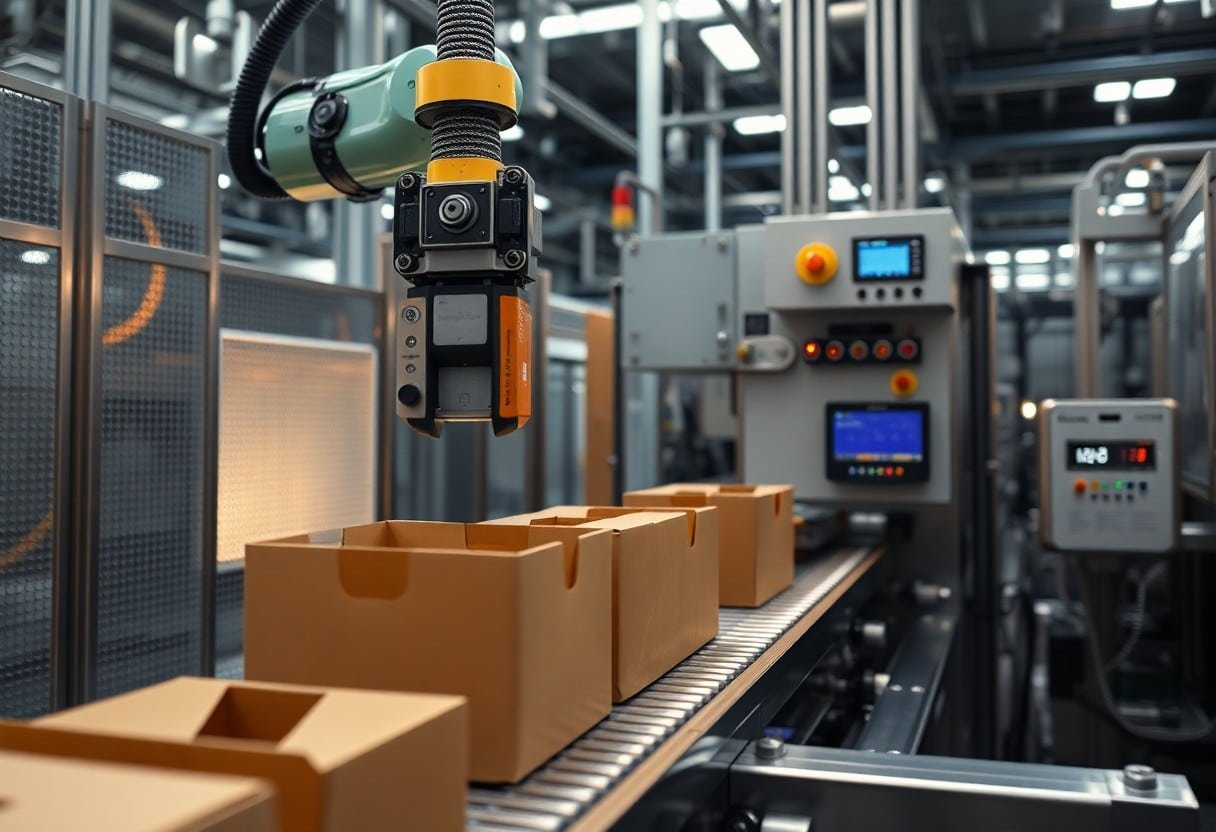
Sensor-driven quality control embeds vision, vibration, weight and spectroscopic sensors into your packaging lines so you detect defects, contamination and mislabels at high speed. By integrating AI models with real-time feeds, you reduce false rejects and downtime while improving yield. For operational context and case studies see AI Will Transform Packaging Operations.
Continuous quality monitoring
Continuous quality monitoring uses inline sensors and AI to analyze every unit so you catch drift, process variation and equipment wear before they escalate. Continuous analytics let you set adaptive thresholds and alerts, enabling faster corrective actions and consistent compliance with standards.
Multi-sensor data fusion
Multi-sensor data fusion combines vision, acoustic, weight and spectral inputs so you achieve richer inspection decisions than any single sensor can provide. AI correlates modalities to distinguish true defects from benign variation, lowering false positives and improving traceability across your line.
You implement multi-sensor fusion by synchronizing timestamps, normalizing inputs and training models that weight each modality based on reliability; this lets you detect subtle contaminants, packaging deformation and fill-level anomalies simultaneously. Edge inference preserves bandwidth and provides low-latency feedback so your operators and PLCs can act immediately, improving uptime and auditability.
Demand forecasting accuracy
AI sharpens your demand forecasting by ingesting sales history, point-of-sale data, market trends and external signals to predict short- and long-term demand with higher precision; this reduces stockouts and overstocks, aligns packaging production with real customer needs, and lets you plan materials, labor and line schedules more efficiently.
Lower inventory holding
With improved forecasts, you can cut safety stock and reduce excess packaging inventory by implementing just-in-time replenishment and automated reorder points; that frees working capital, lowers storage and obsolescence costs, and shortens lead times so your operations remain lean and responsive to sudden demand shifts.
Machine learning forecasts
Machine learning models detect complex patterns across SKUs, promotions and seasonality so you get finer-grained, SKU-level forecasts that adapt as new data arrives; this lets you prioritize packaging runs and reduce changeovers based on predicted demand peaks and valleys.
You can deploy time-series algorithms, gradient boosting and deep learning ensembles to combine internal sales, promotions, pricing and external factors like weather and economic indicators; continuous retraining, feature engineering and explainable outputs help you monitor model drift, improve MAPE and translate forecasts into actionable packaging schedules and procurement plans.
Energy usage optimization
You can reduce facility energy use by applying AI to monitor real-time consumption, identify wasteful processes and optimize machine schedules; integrating IoT sensors and demand forecasts lets you maintain throughput while lowering peak loads and balancing energy across lines.
Reduced energy costs
By shifting operations away from peak tariffs, deploying predictive maintenance to avoid inefficient runs, and auto-scaling equipment based on demand forecasts, you cut utility bills and capture demand-response incentives, producing measurable reductions in your energy spend.
AI-driven process controls
AI-driven process controls let you fine-tune temperature, conveyor speed and actuator timing through closed-loop learning, minimizing variability and energy loss while preserving product quality as the system adapts to material and environmental changes.
Techniques like model predictive control and reinforcement learning build digital twins of your lines so you can simulate energy trade-offs before implementing changes; edge AI connects to PLCs to enforce optimized setpoints in milliseconds, enabling you to lower cycle energy by adjusting profiles based on live sensor feedback and production priorities.
Automated palletizing and sorting
AI-driven automated palletizing and sorting lets you move pallets faster and with fewer errors by coordinating robots, conveyors and software. Machine learning optimizes stacking patterns for weight and stability, adapts to SKU variations, and integrates with your warehouse management system to raise throughput, reduce damage and streamline loading for shipping.
Faster order fulfillment
By using AI to prioritize orders, optimize picking routes and manage dynamic slotting, you can shorten cycle times and increase daily shipments. Real-time analytics predict bottlenecks, automate batch picking, and coordinate robots with human pickers so your fulfillment meets tighter SLAs and seasonal spikes without sacrificing accuracy.
Vision-guided robots
Vision-guided robots combine high-resolution cameras and AI models so you can reliably identify, orient and grasp products across varied shapes and labels. They handle irregular items, reduce mispicks, and adjust in real time to conveyor speed or lighting changes, improving consistency in sorting and palletizing operations.
Using 3D vision, depth sensors and convolutional neural networks, vision-guided robots execute complex bin-picking and gentle grasping while doing inline quality inspection so you can detect damaged goods before palletizing. Integration with your PLCs and WMS enables closed-loop feedback for continuous learning, lowering cycle time and increasing uptime with remote model updates.
Waste reduction strategies
AI-driven systems identify inefficiencies across design, production, and logistics so you cut waste before it accumulates. By combining predictive demand forecasting, automated quality inspection, and material optimization, you reduce overpackaging, rejects, and excess inventory. These measures lower costs and environmental impact while keeping production agile and responsive to changing customer needs.
Less material waste
You can use AI to right-size packaging through generative design and simulation, reducing unnecessary layers and fillers. Machine learning models analyze product dimensions, fragility, and shipping patterns so your packaging uses less material without compromising protection. This optimizes palletization and lowers shipping costs while supporting sustainable sourcing and circular design initiatives.
Process optimization algorithms
Process optimization algorithms help you streamline lines by minimizing changeovers, balancing workloads, and reducing defect rates. Reinforcement learning and scheduling solvers adapt in real time to demand and equipment status, so your throughput increases and scrap falls. Integration with inspection and maintenance systems ensures continuous improvement across production stages.
Advanced techniques like model predictive control, digital twins, and genetic algorithms let you simulate trade-offs between speed, quality, and waste in virtual environments before applying changes on the floor. Real-time telemetry feeds and closed-loop control enable immediate corrections, and integration with MES or SCADA gives you end-to-end visibility to quantify waste reductions and ROI.
Summing up
Taking this into account, you can leverage AI-driven vision systems, predictive maintenance, robotic pick-and-place and optimized routing to reduce downtime, cut waste, and accelerate throughput, while real-time analytics and adaptive packaging let you scale faster and maintain quality; adopting these ten proven AI strategies gives your operations measurable automation and efficiency gains.