
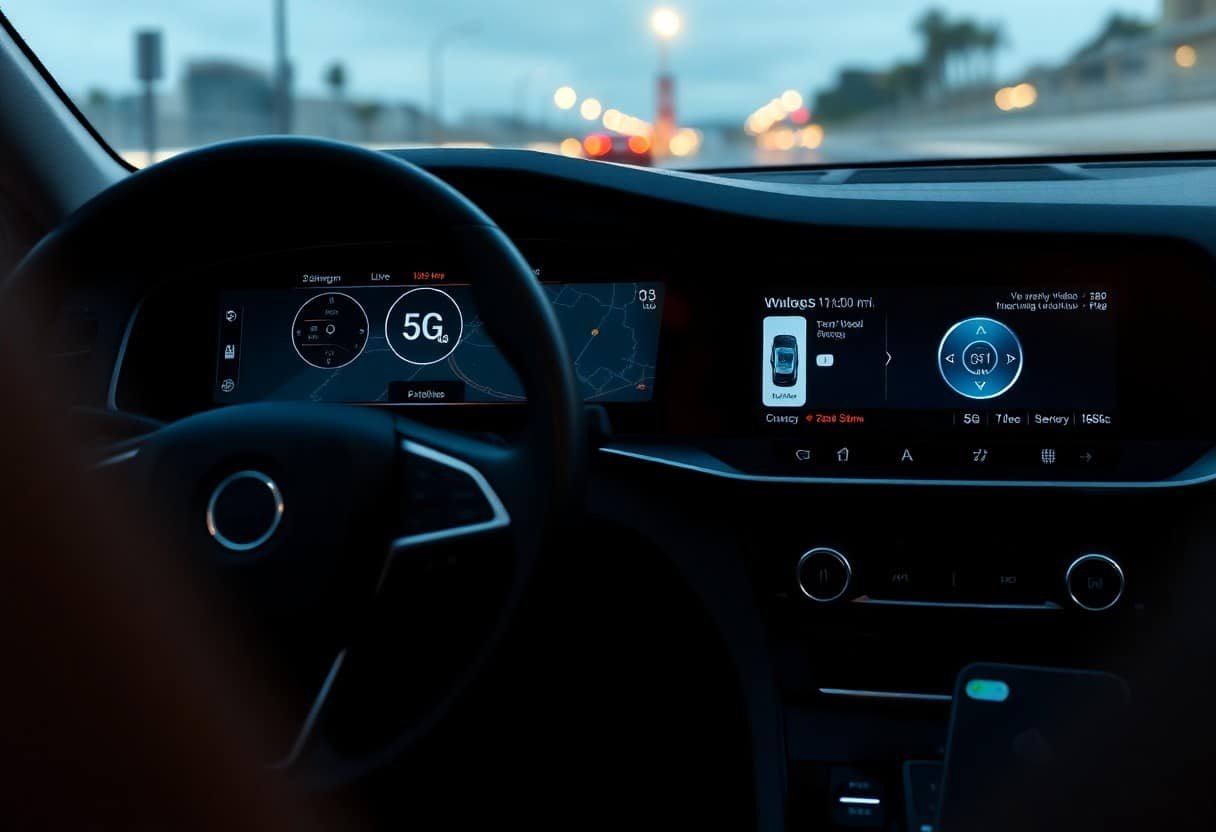
With 5G’s low latency and greater bandwidth, you gain the foundation for responsive, multimedia-rich in-car interfaces that adapt to your needs in real time. This connectivity enables continuous navigation updates, cloud-based voice assistants, immersive AR displays, and vehicle-to-everything exchanges that keep your driving experience safe, personalized, and seamlessly connected.
Key Takeaways:
- 5G’s low latency and high bandwidth enable true real-time in-car interactions-vehicle-to-everything (V2X) messaging, cloud-assisted processing, live map/traffic updates, and AR-enhanced HUDs.
- Enhanced connectivity improves UX by enabling seamless high-quality streaming, more responsive voice/gesture controls, faster OTA updates, and offloaded edge/cloud compute for advanced driver assistance and personalization.
- Real-world benefit depends on network coverage, edge infrastructure, cybersecurity and privacy safeguards, and reliable fallback to LTE to maintain service where 5G is weak.
Understanding 5G Technology
Definition of 5G
5G, the Fifth Generation of mobile networks defined in 3GPP Release 15 and beyond, delivers peak speeds up to 10 Gbps and latencies approaching 1 ms in optimized setups; it combines eMBB (enhanced mobile broadband), URLLC (ultra-reliable low-latency communications) and mMTC (massive machine-type communications). You can rely on sub-6 GHz for wide coverage and mmWave (24-52 GHz) for dense, high-bandwidth use cases like multi-camera HD streaming and over-the-air software updates.
Evolution from 4G to 5G
Where 4G LTE typically gave you 10-100 Mbps and 30-50 ms latency, 5G elevates throughput to 1-10 Gbps and latency down to single-digit milliseconds for real-world links; key shifts include network slicing for per-service SLAs, edge computing to host vehicle workloads near base stations, and software-defined cores that let you provision QoS dynamically for safety messages versus infotainment.
Technically, the move involved new radio techniques-Massive MIMO and beamforming multiply spectral efficiency while mmWave adds untapped spectrum but requires densified cells and small cells in urban corridors. You’ll see multi-access edge computing (MEC) colocated with roadside units, vendors like Qualcomm and Ericsson supplying 5G NR chipsets and base stations, and early deployments (e.g., city mmWave pilots) proving low-latency V2X and real-time map offloading at scale.
The Role of 5G in In-Car User Experience
With 5G’s sub-10 ms latency and urban throughput often reaching hundreds of Mbps to 1 Gbps, you get seamless streaming, faster map updates and more reliable V2X links; network slicing and MEC let automakers guarantee bandwidth for safety systems while delivering premium infotainment. See industry findings in The Impact of 5G on Autonomous Driving and Connected ….
Enhanced Connectivity
5G supports up to 1 million devices per km² and offers network slicing so your vehicle can run dozens of sensors, passenger devices and V2X radios without contention; OEMs use this to push OTA maps, security patches and high-resolution traffic data concurrently, enabling fleet-wide updates during off-peak hours while preserving bandwidth for telematics.
Improved Real-Time Interaction
Lower latency and URLLC let you interact with live services-AR HUD overlays, cloud gaming and teleoperation-while cooperative perception shares LIDAR and camera feeds between vehicles; edge-assisted processing in trials has driven perception and decision latencies into single-digit milliseconds, improving ADAS reaction times and remote-assist responsiveness.
By combining 5G NR V2X, MEC and sidelink modes, you experience cooperative safety message rates of 10-100 Hz and round‑trip times often below 10 ms; that enables remote operators to assist stalled vehicles, supports lane‑level AR navigation from near‑real‑time point clouds, and allows predictive maintenance alerts based on streamed sensor telemetry in urban pilot programs.
Applications of 5G in Automotive Industry
5G unlocks low-latency V2X communication, high-throughput media streaming, and massive sensor offloading so you get seamless in-car services; for deeper technical and industry examples see How IoT and 5G Are Shaping Automotive Technology, where deployments and IoT integration demonstrate real-world ROI across fleets and consumer vehicles.
Autonomous Driving
With latency as low as 1 ms and peak speeds up to 10 Gbps, 5G lets your vehicle share radar/lidar feeds and HD camera streams with nearby cars and edge servers for cooperative perception; this enables faster trajectory planning, reduces decision lag from ~100 ms toward single-digit milliseconds, and supports over-the-air model updates so your AV stack improves continuously.
Advanced Navigation Systems
5G lets your navigation system receive HD map deltas, live sensor-based road hazard alerts, and crowd-sourced traffic telemetry in seconds rather than minutes, enabling route replans, lane-level guidance, and AR heads-up displays that update in near real time using edge compute for sub-50 ms responsiveness.
- Your vehicle streams compressed sensor tiles to the edge for cooperative mapping and instant rerouting.
- You receive lane-precise traffic warnings via cellular V2X broadcasts in dense urban corridors.
- Your in-car AR navigation overlays update with centimeter-level alignment using synchronized 5G timing.
Advanced Navigation: Feature / Benefit
| Feature | Benefit to you |
| Edge-based HD map updates | Route accuracy improves, reducing wrong-turns and wasted time |
| Low-latency hazard alerts | Faster evasive guidance and safer maneuvers |
| AR HUD integration | Clearer, less distracting instructions aligned to real world |
When you combine onboard sensors with 5G-enabled crowd data, map providers can push incremental HD-tile changes to your car every few seconds, letting your route adjust dynamically to construction, temporary lane shifts, or micro-congestion; pilot projects in Europe and Asia already show lane-level updates and platoon-aware routing cutting travel time variability by tangible margins.
- You benefit from prioritized slices for navigation during congestion, keeping critical packets timely.
- Your system leverages multi-access edge compute (MEC) to run SLAM offload and reduce CPU load onboard.
- You get secure OTA pushes for map and ML-model updates over encrypted 5G slices.
Navigation Tech / Operational Impact
| Navigation Tech | Operational Impact for you |
| Network slicing with QoS | Guaranteed latency for guidance and safety messages |
| MEC-based map fusion | Faster map refreshes and reduced in-vehicle compute costs |
| Encrypted V2X messaging | Improved trustworthiness of shared traffic/hazard data |
Challenges and Considerations
You must manage uneven 5G coverage, spectrum fragmentation and interoperability between OEM, telco and cloud providers; mmWave demands small-cell density (often 200-250 km/h. Latency targets for URLLC (≈1 ms) and reliability SLAs conflict with cost constraints, and business models for roaming, data ownership and software updates remain unresolved across regions and standards bodies.
Infrastructure Requirements
You’ll need dense small-cell deployment, fiber or high-capacity microwave backhaul (10-100 Gbps per site), and edge compute (MEC) to hit sub-10 ms application latencies. Network slicing, cloud‑native 5G cores, C-RAN and support for NR‑V2X/C‑V2X are necessary for prioritizing in-vehicle traffic, while power, site zoning and spectrum licensing (mid‑band and mmWave) drive capex and rollout timelines.
Security and Privacy Concerns
You face a larger attack surface as vehicles exchange telematics, sensor and location data over public networks; threats include V2X spoofing, OTA tampering and telemetry exfiltration. Compliance with GDPR/CCPA and automotive regulations adds legal risk, and adversaries exploiting weak supply-chain components or remote telematics can compromise safety and user trust.
You should adopt ISO/SAE 21434 and UNECE R155-aligned processes, hardware root-of-trust, PKI-based mutual authentication, secure elements/eSIM and signed OTA with rollback protection. Deploy anomaly detection, end-to-end encryption and consent-driven telemetry minimization; coordinate threat intelligence with telcos and Tier-1s-lessons from the 2015 Jeep Cherokee remote exploit show that remote telematics vulnerabilities can translate directly into vehicle control risks.
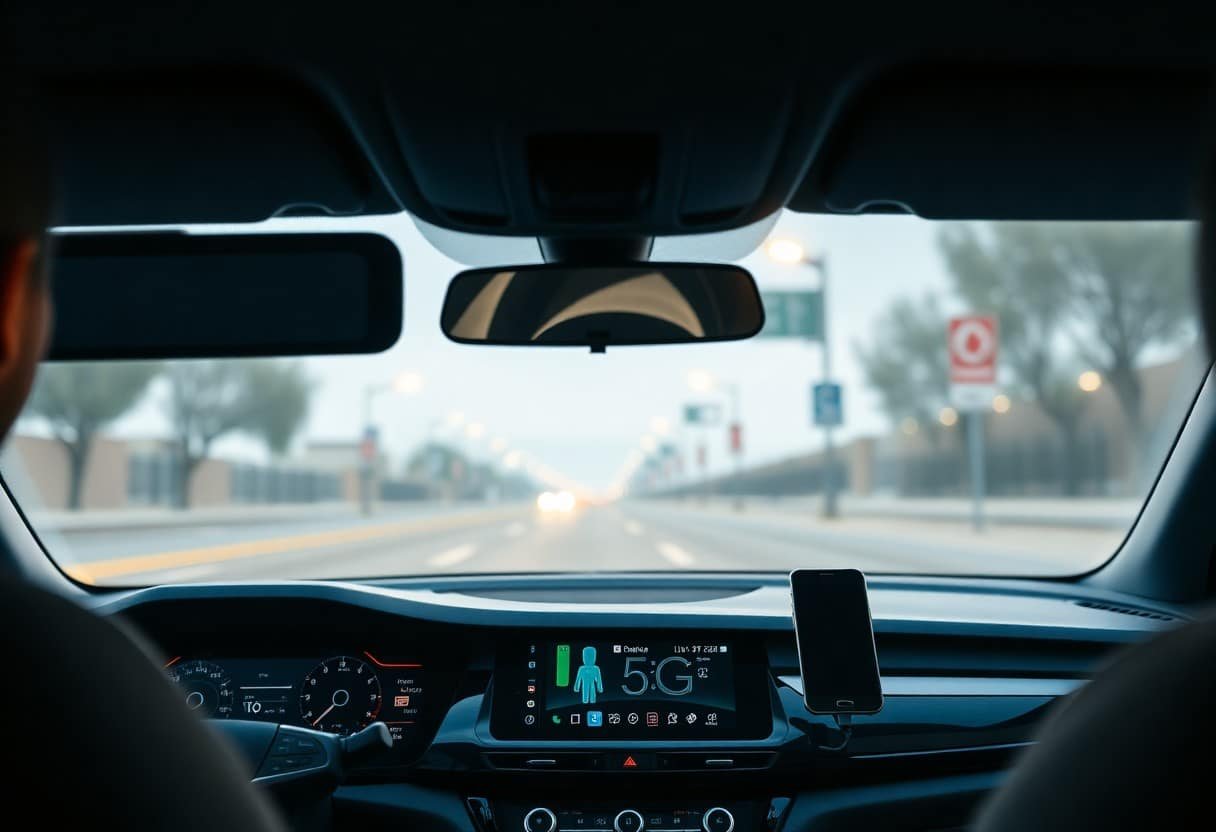
Future Trends in 5G and In-Car UX
Expect network slicing, edge compute, and mmWave capacity to reshape in-car UX: mmWave can deliver gigabit peak speeds while 5G standalone targets sub-10 ms latency for URLLC use cases. OEM pilots report OTA updates and map syncs completing in minutes instead of hours. In practice, this lets you run real-time AR navigation, cloud-assisted edge inference, and multi-passenger 4K streaming without stalls, enabling seamless handoffs between mobile networks and in-vehicle systems.
Integration with IoT Devices
By connecting your car to home and city IoT, 5G supports up to 1 million devices/km², enabling instant interactions with smart locks, energy systems, and traffic infrastructure. Fleet operators can stream telemetry at sub-10 ms intervals for predictive maintenance, and households can trigger HVAC preconditioning when your vehicle is five minutes away. Edge nodes reduce backhaul, so camera feeds and sensor fusion run locally for low-latency V2X safety messages and synchronized smart-home handoffs.
Potential for Personalization
Personalization will move from static profiles to continuous, context-aware experiences: in-cabin sensors, historical trip data, and cloud models let the system adjust seat position, climate, and media automatically. Real-time traffic, calendar events, and biometric cues inform route choices and content recommendations, while network-assisted models keep heavy computation at the edge so your preferences update within seconds.
Combine on-device ML with edge inference to balance privacy and responsiveness: run driver identification locally and send anonymized feature vectors to edge models for richer recommendations. That setup can deliver UI adaptations and safety alerts in under 100 ms, support A/B testing across millions of trips, and let you opt into personalized services that improve over time without continuous raw-data uploads.
Case Studies and Real-World Examples
You can see 5G driving measurable UX gains in live deployments: trials report end-to-end latencies under 10 ms, peak throughputs up to 1 Gbps, and OTA update times reduced from hours to minutes, enabling richer maps, seamless streaming, and faster telematics for drivers and passengers.
- 1) Audi + Ericsson trials: achieved sub‑10 ms latency in controlled V2X tests and >99.9% packet delivery reliability for cooperative maneuvers, demonstrating millisecond-class warnings for intersection safety.
- 2) BMW + Qualcomm implementations: 5G modems in pilot fleets delivered sustained 200-600 Mbps downloads for high-quality OTA map and infotainment updates, cutting average update time by roughly 60% versus LTE.
- 3) Ford + major US carrier pilots: live demos streamed multiple HD camera feeds for remote diagnostics at ~50 ms round‑trip latency, enabling faster fault diagnosis and reduced workshop time per vehicle.
- 4) Chinese OEMs (BYD/SAIC) urban pilots: edge-hosted HD map streaming for ADAS reduced local compute load and achieved 10-20 ms response times in dense-city scenarios with fleets of 20-100 vehicles.
- 5) Smart‑city V2X deployments in Europe: municipal pilots across 5-10 intersections reported up to 30% fewer emergency braking events during 5G-enabled signal phasing experiments.
- 6) CX and digital engagement studies: enterprise reports like The Connected Car Customer & the Digital highlight improved in-car purchase conversion and NPS uplift when low-latency personalization and seamless billing are enabled by faster connectivity.
Leading Automotive Brands
You’ll find major OEMs-Audi, BMW, Mercedes‑Benz, Ford, GM and several Asian brands-integrating 5G to support HD mapping, multi‑camera telematics and OTT entertainment; 5G’s 1 Gbps peak rates and 1-10 ms latency let these brands deliver features that were impractical on LTE.
Pilot Projects and Initiatives
You can track dozens of pilots worldwide that pair telcos, OEMs and vendors to validate latency, reliability and business models; typical pilots run 6-18 months, involve 5-100 vehicles, and measure metrics like latency, packet loss and OTA update throughput.
More details show pilots focus on three vectors: V2X safety (sub‑10 ms alerts), edge‑assisted ADAS (reducing on‑vehicle compute and delivering map updates in seconds) and in‑car media/commerce (streaming at 100-600 Mbps). Partners commonly include telcos (Verizon, Vodafone), network vendors (Ericsson, Nokia) and silicon providers (Qualcomm), enabling repeatable metrics you can benchmark for your own rollouts.
Final Words
Drawing together, 5G’s low latency, high bandwidth, and edge computing enable responsive interfaces, live over-the-air updates, and safety-critical communication, letting you interact with your in-car systems and cloud services in real time; you must still weigh network coverage, cybersecurity, and integration challenges to achieve a truly seamless UX.